
Decoding Your Tire Size: What the Numbers Really Mean and Why They Matter
Decoding Your Tire Size: What the Numbers Really Mean and Why They Matter
TL;DR
- A tire size is a machine-readable specification, not a description; it encodes geometry, load capacity, heat tolerance, and system compatibility.
- The full tire code (example: P235/65R17 105H XL) contains multiple engineering variables that affect safety and performance.
- Load Index and Speed Rating are structural limits that determine whether a tire can safely support your vehicle.
- Rolling diameter is a calibration input for ABS, AWD, stability control, and transmission shift logic.
- OEM tire sizes exist to protect vehicle systems, not to restrict consumer choice.
What a Tire Size Really Is
A tire size is a performance envelope defined by standards and engineering constraints. It tells the vehicle how the tire will deform, carry weight, dissipate heat, and roll under load. It is not a simple measurement of how big a tire looks.
Vehicle systems are calibrated around specific tire behavior, including rolling diameter, sidewall stiffness, and load capacity. If those variables change, the vehicle’s braking and stability logic may no longer match real-world wheel behavior.
This is why two tires that look similar can behave differently in braking, stability, and wear: the vehicle interacts with a tire as a dynamic spring and rotating mass, not just rubber on a rim.
The Full Tire Code (What You’re Actually Decoding)
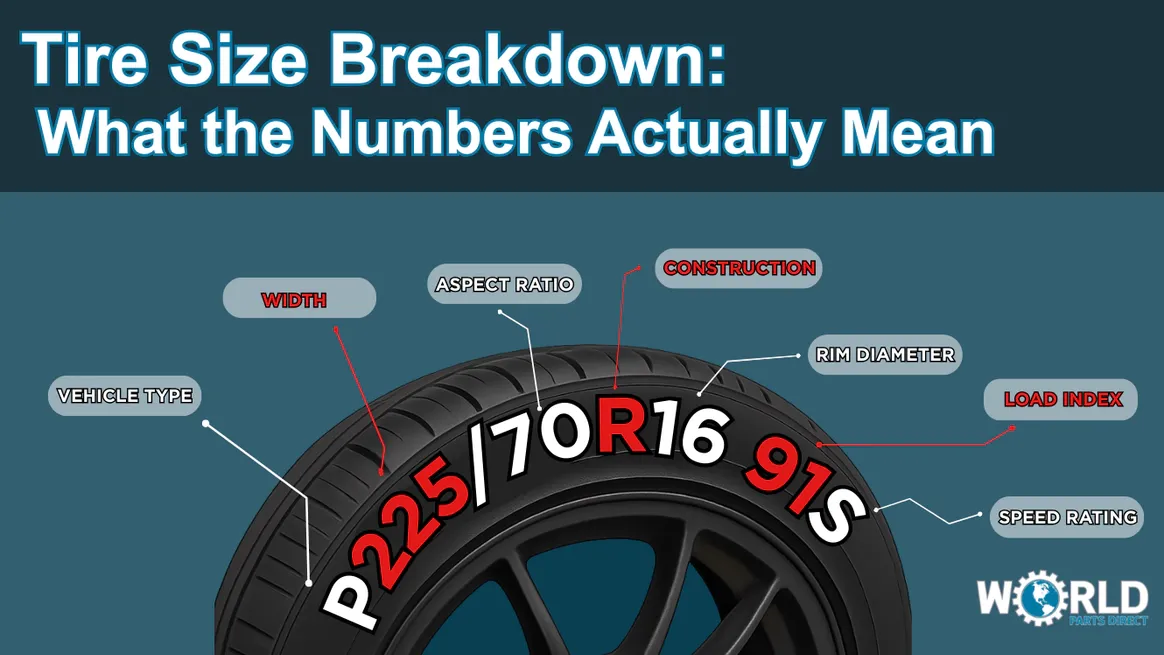
A modern tire is commonly labeled like this: P235/65R17 105H XL. This string contains multiple variables that define geometry, construction, and operating limits.
Example code: P235/65R17 105H XL
- P = Tire type (Passenger)
- 235 = Section width (mm)
- 65 = Aspect ratio
- R = Construction type (Radial construction)
- 17 = Wheel diameter (inches)
- 105 = Load Index
- H = Speed Rating
- XL = Service type (Extra Load)
Many guides stop after the first five elements. For fitment and safety, the last three are often the deciding factors.
1) Tire Type Prefix (P, LT, ST, Euro-Metric)
The prefix defines the tire’s structural class and intended duty cycle. It is the first indicator of how a tire is built and what loads it is designed to sustain.
- P = Passenger (cars, crossovers, many light SUVs)
- LT = Light Truck (trucks, towing, heavy-duty SUVs)
- ST = Special Trailer (trailers only; not designed for driven axles)
- No prefix = Euro-Metric (often higher-load passenger specification)
An LT tire and a P tire with similar dimensions are not interchangeable. LT tires typically use thicker sidewalls and stronger belt packages, which affects ride quality, handling response, and thermal tolerance under load.
2) Section Width (235)
Section width is measured in millimeters from sidewall to sidewall when mounted and inflated under standardized conditions. It is not the tread width.
Section width influences contact patch shape, rolling resistance, and hydroplaning behavior. Wider tires can improve dry grip but may hydroplane sooner and increase drag. Narrower tires can improve wet and snow performance by cutting through standing water and slush more effectively.
3) Aspect Ratio (65)
Aspect ratio is the sidewall height expressed as a percentage of section width. A higher aspect ratio increases sidewall height and typically improves impact compliance. A lower aspect ratio reduces sidewall flex and typically sharpens steering response.
Changing aspect ratio alters sidewall stiffness and, if not compensated, changes rolling diameter and system calibration.
4) Construction Type (R)
Radial construction uses belt layers that stabilize the tread and improve heat dissipation. Most modern passenger vehicles are engineered around radial behavior, including casing stiffness and thermal stability.
5) Wheel Diameter (17)
This number indicates the wheel diameter the tire is designed to mount on. It is not the tire’s overall height.
Changing wheel diameter without adjusting aspect ratio typically changes rolling diameter and can affect braking leverage, ride harshness, and stability-control calibration.) Load Index (105)
Load Index is the tire’s per-tire load capacity at a specified inflation pressure. It is a primary safety constraint on SUVs, trucks, and EVs due to higher curb weight and axle loads.
- 95 = 1,521 lbs per tire
- 105 = 2,039 lbs per tire
- 115 = 2,679 lbs per tire
Two tires with the same dimensions can differ by more than 2,000 pounds of total vehicle capacity across four tires. Matching load index to the vehicle specification is non-negotiable.
6) Speed Rating (H)
Speed Rating is primarily a measure of heat tolerance and structural stability, not a statement of how fast you plan to drive.
- T = comfort-focused casing behavior
- H = balanced stability and ride
- V = higher thermal tolerance and stability
- W/Y = maximum stability class
Higher speed ratings often correlate with stronger internal construction and more stable braking response under load.
7) Service Type (XL, SL, RF)
Service markings provide additional detail about operating capacity and casing reinforcement.
- XL = Extra Load
- SL = Standard Load
- RF = Reinforced
These markings matter when matching tires to heavier vehicles or higher axle loads, and they can affect ride stiffness and thermal behavior.
Why Rolling Diameter Controls Vehicle Systems
Rolling diameter determines distance traveled per wheel rotation. Vehicle systems use wheel-speed data to infer acceleration, slip, and vehicle speed.
Changes in rolling diameter affect the speedometer, ABS logic, TPMS calibration behavior, stability control thresholds, AWD torque decisions, and transmission shift strategy. Even a small percentage change can produce system-level side effects.
Why OEM Tire Specifications Exist
OEM tire specification is selected to match suspension geometry, braking capability, electronic stability behavior, and driveline durability. This is a system-level decision that accounts for load limits, thermal tolerance, and predictable deformation under real-world stress.
Changing tire size without maintaining rolling diameter and operating limits shifts stress into brakes, suspension components, and driveline systems.
Final Synthesis
Your tire size is not a label. It is a machine-readable contract that defines rolling diameter, section width, aspect ratio, radial construction, Load Index, Speed Rating, and service capacity.
When these variables match the OEM specification, the vehicle’s braking, stability control, and driveline logic operate as designed. When they do not, the vehicle’s safety margins and component life can degrade even if the tire appears to fit.
FAQ
How does tire size affect speedometer accuracy?
Speedometer accuracy depends on rolling diameter. A larger diameter travels farther per rotation and makes the speedometer read lower than actual speed; a smaller diameter does the opposite.
Why do two tires with the same size feel different?
Two tires with the same printed size can use different casing designs, compounds, and belt packages. Differences in Load Index, Speed Rating, and service markings (XL/SL/RF) change stiffness, heat behavior, and braking stability.
Why do EVs and SUVs often need higher load ratings?
EVs and many SUVs carry higher curb weight and generate higher torque loads. That increases thermal and structural demand, making Load Index and casing design more critical.
Can I plus-size my wheels without causing problems?
Plus-sizing can work when overall rolling diameter, load index, and speed rating remain within OEM tolerance. A mismatch can affect ABS, AWD, and shift behavior.
Where do I find my OEM tire specification?
Use the door jamb placard and the owner’s manual as primary sources. For trim-level and option-package differences, VIN-based fitment tools provide the most precise match.

About World Parts Direct
World Parts Direct is your go-to source for genuine OEM parts for GM and MOPAR vehicles. We make it easy to order factory-original parts online — shipped fast, accurately, and backed by real human support.
Every item we sell comes brand new in the manufacturer’s original packaging. Whether you’re handling routine maintenance, collision repair, or a full restoration, our parts professionals provide VIN-verified fitment support to ensure you get exactly what you need.
Serving drivers and repair shops worldwide, we proudly support brands like Chevrolet, GMC, Cadillac, Buick, Dodge, Chrysler, Jeep, and Ram. Shop confidently at WorldPartsDirect.com.