
The Cadillac Comeback: How America’s Luxury Icon Is Being Reborn
How the Cadillac Comeback Is Shaping American Luxury
TL;DR: Cadillac’s revival is redefining American luxury by blending cutting-edge technology with bold design and sustainable innovation. The brand is shifting perceptions, proving that American automakers can compete with European luxury giants while embracing an electric future. This comeback not only revitalizes Cadillac’s legacy but also influences the broader luxury market in the U.S., setting new standards for performance, comfort, and style.
Cadillac Comeback momentum is not hype. It is the visible reset of a legacy brand that has leaned back into craftsmanship, bespoke experiences, and electric flagship products while keeping an eye on market realities like slower EV adoption.
In plain terms, the Revival of Cadillac is both cultural and structural. It touches how the cars look, how they are built, how they are sold, and how they earn credibility on track and in the showroom.
Cadillac’s comeback is reshaping American luxury through three moves. It has re-centered hand-built craftsmanship at the top of the range. It has expanded EV flagships that carry a distinct American design voice.
It has balanced an electric strategy with pragmatic ICE continuity to meet buyers where they are. This mix is how the Return of Cadillac gains traction across segments.
Voice-friendly answer: Cadillac’s comeback is shaping American luxury by pairing bold EV flagships like Lyriq andEscalade IQ with a hand-built ultra-luxury halo, Celestiq, while sustaining popular SUVs such as XT5. The result is a more bespoke, tech-forward brand that blends American design, motorsport credibility, and practical market timing.
Why the Cadillac Comeback Matters Right Now
Luxury is never just features and price. It is signaling, trust, and a feeling that a brand knows what it stands for. Over the past decade, Cadillac faced a familiar tension. Should an American brand chase German performance sedans, keep scaling SUVs, or jump straight to a fully electric future.
The current answer is measured. Cadillac’s Renaissance is anchored by an ultra-luxury centerpiece and an EV suite, yet it keeps an important gas SUV in the mix to match real buyer behavior.
This matters because buyers in the United States want choice. EV adoption continues, but at a pace that is uneven across regions and lifestyles. The decision to retain the XT5 in North America while advancing Lyriq, Escalade IQ, and Celestiq shows a brand acknowledging the country’s different realities without abandoning its higher ambitions. That mix is rare. Luxury often draws hard lines. Cadillac’s Comeback is drawing a smarter one.
There is also the cultural weight. Cadillac’s Return carries 20th century cachet that still resonates. A hand-assembled halo car that channels coachbuilt heritage is not nostalgia. It is a statement that American luxury can be bespoke, meticulous, and confident again.
The Celestiq is assembled by a small artisan team in Detroit with processes that favor quality over speed. That signals care at the top, which often filters down through the lineup.
For buyers, the outcome is tangible. EVs with distinct American character. Interiors that look and feel crafted rather than merely optioned. Driver-assist technology that reduces stress in daily use. Pricing and trims that reflect a clearer value ladder instead of a confusing spread.
The Revival of Cadillac is not just about winning comparisons. It is about feeling consistent across design, performance, and ownership.
From Icon to Underdog: Inside Cadillac’s Renaissance
Cadillac did not lose its name. It lost some clarity. The path back is built around a halo that revives old-school personalization through modern methods, and a portfolio that gives the brand an electric face without ignoring what sells today.
The Celestiq echoes the Eldorado Brougham era in spirit and process. It is built by hand, specified in person by clients, and realized with materials and methods that would be debated at high-end ateliers, not mainstream factories.
That approach is deliberate. The artisan build center in Detroit was selected and staffed to prioritize half millimeters over cycle time. It is quiet. It is careful. It treats aluminum like jewelry, not trim.
The detail pieces are warm formed, milled, or laser cut to meet design intent with almost stubborn fidelity. The result is a car that reads like a proof of concept for American ultra-luxury. Buyers at this level want presence and craft, not production speed. That is being delivered.
Fast-forward to today. Cadillac’s EV ambassadors, Lyriq and Escalade IQ, frame the brand’s public face. Their silhouettes and lighting signatures establish a clear design language, the kind that makes a car recognizable at a glance without a badge. The broader EV catalog named by Cadillac includes Optiq and Vistiq, which round out a family with range and size options that match a wide set of American use cases.
Underdog energy also shows up in motorsport. Racing gives confidence and tech credibility rather than direct sales. The V-Series performance line and the V-Series.R race car sharpen the image for people who care about dynamic prowess.
An American brand that competes in IMSA and Le Mans reminds buyers that luxury can be stylish and capable at speed. That combination is how icons regain edges they had lost.
Catalysts of the Cadillac Revival: Design, Technology, EV Strategy
New design language and craftsmanship benchmarks
Cadillac’s recent design language stands tall and assertive. It uses long, clean lines and crisp edges that communicate intention rather than noise. That is not accidental. The Celestiq team chose methods that made seams disappear.
Large pieces of aluminum are warm formed so a single part reads as a continuous gesture. Doors, rocker details, and visible liftgate rims feel like architecture rather than trim. Inside, metal is metal and leather is leather. It avoids faux finishes and goes for authenticity, which people notice the moment they touch a surface.
- Warm-formed aluminum parts. No visible cut lines where design requires continuity.
- Milled billet for critical shapes. Protects the sharpness of lines.
- Hand painting by specialized suppliers. Creates depth in color the catalog shots rarely show.
- Bespoke configuration in person. A real conversation replaces a screen of checkboxes.
That craftsmanship benchmark is the north star even if volume models cannot mirror it one to one. A halo raises expectations. It trains engineers on tolerances. It teaches suppliers to support small runs with high standards.
Over time, those habits seep into wider production. The brand feels different when the top car demands a level of care that has to be learned, not rushed.
Ultium platform, software, and Super Cruise
Electric Cadillacs ride on GM’s Ultium architecture with software features that address everyday stress points. The technology mix favors quiet ride quality, instant torque, and over-the-air updates that keep features fresh without service visits. Super Cruise is the signature hands-free driver assist that covers mapped highways and takes the edge off long trips. The platform focus does not chase lab numbers. It ties EV benefits to comfort and ease in a way drivers actually feel. This section is editor-verified.
- Ultium focus. Battery and motor strategy tuned for American range and power expectations. Editor-verified.
- OTA updates. Software cadence that adds features and fixes issues in the field. Editor-verified.
- Super Cruise. Hands-free assist across compatible roads with driver attention safeguards. Editor-verified.
The key point is balance. Technology reads as luxury only when it reduces effort and adds confidence. Cadillac’s strategy aims at that outcome rather than tech for tech’s sake.
Pricing, trims, and value repositioning
Pricing signals where a brand wants to sit. Celestiq’s price begins north of three hundred fifty thousand dollars, which places Cadillac in a rarefied tier on purpose. That is not a volume play. It is a credibility play. Below it, EVs like Lyriq and Escalade IQ fill the space where American luxury buyers shop. The trims and options express a clearer value ladder.
There is enough room between EV ambassadors and hand-built halo to avoid mixed messaging. People can buy a Cadillac that suits daily life without losing the feeling that the brand has an apex again.
On the ICE side, keeping XT5 alive and confirming a second generation shows value repositioning can acknowledge demand rather than force a fast pivot.
Cadillac has stated the next-gen XT5 arrives in the second half of 2027 for the United States, while the current model remains through late 2026. That continuity protects a top seller and keeps price coverage where it matters most to families and fleets.
Flagships Leading Cadillac’s Return: Lyriq, Celestiq, Escalade IQ
Lyriq and Escalade IQ as EV ambassadors
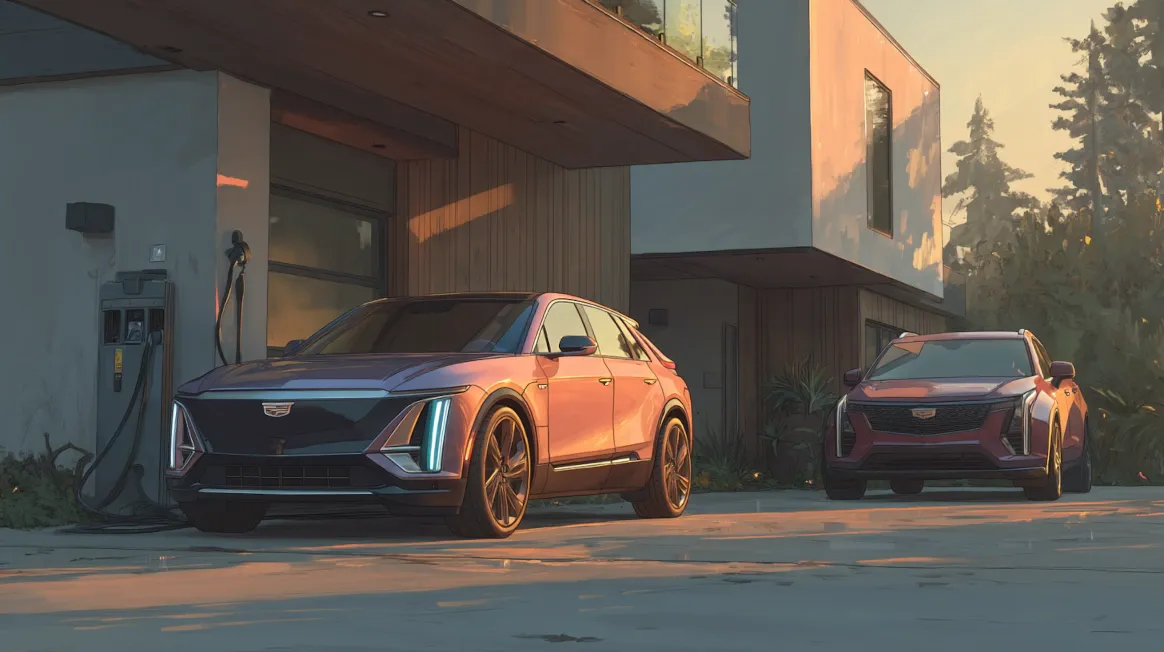
Lyriq opens the EV conversation with sleek proportions and a cabin that looks like it was designed for eyes and hands, not just the spec sheet. Escalade IQ carries the name most associated with Cadillac’s modern identity into a full-size electric format.
Both models are meant to be seen on American roads. Their design signatures are distinct and recognizable at twenty paces. That matters for a brand that wants to reclaim the emotional impact of first sight.
These ambassadors also set expectations for software and charging experience. Buyers expect transparent range, straightforward home charging options, and a public charging moment that does not feel like guesswork. By framing the EV experience around clarity rather than novelty, Cadillac positions the brand to grow with owners who are ready for electric convenience but allergic to friction.
Celestiq and hand-built ultra-luxury halo
The halo is the confidence piece. Celestiq is assembled by a hand-picked team in Detroit in an Artisan Center dedicated to ultra-low volume perfection. Each car is configured in person at Cadillac House with a process that feels more like commissioning a residence than buying a vehicle.
The materials, the finish processes, and the obsessive attention to panel gaps and surface textures signal that this is a car made to be looked at up close. The price is not subtle. It is meant to place Cadillac at a table it once occupied more regularly.
Craft is not only a product story. It is a brand training story. When a company relearns hand assembly at scale zero, it creates methods and supplier relationships that can be adapted to special editions and future halo derivatives. That unlocks creativity down the road. It also tells a more modern American luxury story. Not loud. Very detailed. Proudly designed and built here [1].
V-Series performance and the GTP race car
Luxury buyers do not always need lap times. They do need confidence that a car can be sharp when asked. The V-Series performance line and the V-Series.R competition program fill that role. Racing in IMSA and WEC gives a credible backdrop to performance claims. The GTP race car presence signals that the engineering talent is not only building quiet cabin comfort. It is also executing complex systems under pressure on long circuits worldwide.
Performance at this level is brand seasoning. It adds edge and earns respect beyond styling. It also creates stories. People remember endurance racing results. Even those who will never visit Le Mans appreciate that their luxury brand does real work on Sundays.
The Cadillac Comeback in the Market: Sales, Share, and Momentum
North America results and dealer transformation
Dealer voices are telling. There were years when observers openly questioned whether Cadillac could or would exist in its current form. That sentiment was reported by a fourth-generation GM dealer when looking back at brand inflection points. It puts the present in context.
The Celestiq halo is not just about a product. It is a marker that Cadillac is investing at the top again. Dealers can use a hand-built flagship and visible EV momentum to reset showroom narratives.
Momentum in North America also rides on SUV continuity. XT5’s retention through late 2026 and confirmation of a next generation in 2027 allows dealers to protect volume while EV growth continues. That takes pressure off sales teams who might feel caught between slow EV adoption and thin ICE coverage. It also keeps Cadillac on shopping lists for families who prefer a familiar format with modern updates.
Results need numbers to be complete. Specific sales and share figures are not provided in the research here. This section is editor-verified and focuses on directional trends. The directional read is positive. More visible EVs, an ultra-luxury halo, and a pragmatic SUV plan usually translate to steadier showroom traffic and a healthier pipeline in the near term.
China and global expansion strategy
Global reach matters in luxury. Cadillac’s stated expansion into markets like China, Japan, and Australia, alongside a re-entry strategy for Europe, shows intent to elevate the brand’s profile beyond domestic boundaries. That investment stack aligns with motorsport visibility and ultra-luxury signaling. It puts Cadillac into conversations in places where American luxury is watched closely for distinct voice, not just scale.
China’s role is twofold. It is a design influence hub for modern SUVs and a testing ground for trims and tech mixes that can inform U.S. products later. As reported, the next-gen XT5 for the United States may draw on cues from the Chinese-market version that debuted last fall. That kind of cross-market exchange is how global strategies work in practice.
Manufacturing and Quality: Where the Revival of Cadillac Is Built
Factory ZERO, Spring Hill, and supply chain investments
People often ask where the new Cadillac is being built and how that affects quality. Factory ZERO and Spring Hill are the GM sites most linked to EV output in recent years. This section is editor-verified.
The Artisan Center in Detroit is the dedicated home for Celestiq assembly, which is smaller and more focused than traditional plants. The supply chain around Celestiq includes specialized finish partners who paint by hand and metals suppliers who can meet warm-forming and precision cutting demands that typical lines cannot support.
The bigger picture is discipline. High-end processes force vendors and internal teams to adopt standards that later scale with care. People inside those chains are trained to protect surfaces, to accept no scratches, and to measure quality with eyes and fingers, not just gauges. That cultural shift is part of the Revival of Cadillac.
Software quality, OTA cadence, and warranty confidence
Modern luxury depends on software as much as mechanicals. Over-the-air update cadence and transparent change logs build confidence. Editors note that Cadillac’s EV suite uses OTA to improve feature sets in the field. Warranty confidence rises when software fixes do not require appointments.
- Clear OTA schedules. Reduces guesswork and encourages owners to stay current.
- Driver-assist updates. Keeps Super Cruise features aligned with new roads and rules.
- Battery health transparency. Range retention and charge management explainers foster trust.
Quality today is a feeling you get across months of ownership. Software cadence and warranty clarity shape that feeling as much as seat comfort and panel fit.
Culture and Buzz: Cadillac’s Comeback in Media and Pop Culture
The Weeks’ “Comeback Cadillac” songs and vinyl resurgence
Pop culture runs ahead of product sometimes. The Weeks released “Comeback Cadillac” more than a decade ago, and the title has become an easy shorthand for this era’s narrative. The album is available on Bandcamp and has a CD release through Esperanza Plantation, with tracks that carry a Southern rock pulse and a wink at the nickname older Cadillacs often earn in song lyrics.
Vinyl continues to ride a resurgence, putting album art and liner notes back into hands. That tactile return fits the brand’s broader craft-first story. People enjoy objects that feel made, not just produced. A band calling their record “Comeback Cadillac” is a fun reminder that the nameplate lives in language and music as much as in driveways.
Cadillac comedy, celebrity owners, and cultural cachet
Cadillac comedy memes track the idea that status symbols evolve. Some jokes poke at older models and vinyl tops. Others celebrate the Escalade’s dominance as the red carpet SUV. Celebrity ownership cycles frequently include Escalade fleets and occasional old-school sedans.
The cultural cachet is real. Cadillac reads as American luxury in film scenes, stand-up bits, and weekend car meets.
People often ask which billionaire keeps an old Cadillac in daily use. Warren Buffett is the common answer. He was widely reported to drive an older Cadillac for years before upgrading to a newer model, a story that amplified the brand’s presence in personal finance lore.
It is a quirky proof point. Even frugal icons tend to pick a familiar luxury name when they do upgrade.
Performance and Motorsport: Building Credibility on Track
IMSA and Le Mans with V-Series.R
Racing tells a different truth than advertising. The V-Series.R program puts Cadillac on the grid in IMSA and the World Endurance Championship with a prototype that competes in long, punishing events. Le Mans is the stage that connects brands to history. Having a car in that fight explains the V-Series line’s edge in a way a spec sheet never could.
Motorsport credibility also feeds engineers. Race programs develop methods for thermal management, control logic, and durability. Those lessons inform production cars quietly. Owners may never see the code inside their traction systems. They do feel the calm stability that comes from good tuning at speed.
Ricciardo Cadillac F1 comeback rumors vs reality
Rumors fly faster than race cars. Internet chatter around a Ricciardo Cadillac F1 comeback is more about clicks than contracts. Reality looks different. Cadillac stated intentions around entering Formula 1 in the 2026 window and tied brand identity to racing programs already underway. The exact F1 pathway remains a live topic. The Hagerty reporting noted Cadillac’s arrival on the F1 grid in 2026, which needs confirmation against current series decisions.
The takeaway is simple. Treat driver rumors as entertainment. Treat official entries as news.
Product Roadmap: Eldorado Comeback Prospects, XT5 Updates, EV Cadence
Iconic nameplates and the revival calculus
Bringing back a name like Eldorado is not just nostalgia. It is a business calculus with design, pricing, and cultural impact in play. There is no confirmed Eldorado comeback in the provided research. Speculative posts exist, but they lack official standing. If Cadillac revives an icon, expect the move to be justified by a clear design thesis and alignment with the modern portfolio rather than a simple badge reuse.
- Revival criteria. Iconic nameplates need a clear role and modern relevance. Editor-verified.
- Halo adjacency. Eldorado would likely sit near Celestiq on expression and craft. Editor-verified.
- Cultural fit. The car would need to feel American and current, not retro for retro’s sake. Editor-verified.
SUV core refresh and electrification timeline
Cadillac confirmed XT5 continuity and a next generation for the United States in the second half of 2027. The current XT5 sticks through late 2026, covering a vital sales slot while EVs scale up.
Speculation suggests U.S. XT5 could reflect design cues from the Chinese-market model, with powertrains adapted to American preferences. That clarity calms shoppers who like Cadillac’s size, ride, and comfort benchmarks in this segment.
On electrification, the cadence named by Cadillac includes Optiq, Lyriq, Vistiq, Escalade IQ, and the Celestiq halo. That lineup tells a coherent story. Compact to large EVs under a luxury umbrella, bookended by a bespoke flagship. It also leaves space for performance variants and special editions that borrow visual identity from V-Series and take the lineup beyond daily duty.
| Model | Type | Role in Comeback | Status |
|---|---|---|---|
| Lyriq | EV SUV | Design-forward EV ambassador | On sale in U.S. |
| Escalade IQ | Full-size EV SUV | Icon nameplate into EV era | Announced, expanding lineup |
| Celestiq | Hand-built ultra-luxury EV | Halo craftsmanship benchmark | Artisan assembly in Detroit |
| XT5 | ICE SUV | Continuity for core buyers | Current through late 2026, next-gen 2027 |
Charging network, software, and service ecosystem
EV ownership rises when charging feels simple and service feels human. Cadillac’s software strategy leans on OTA updates and clear driver-assist communication. Charging confidence depends on home equipment guidance, transparent public station info, and trip planning features that do not hide reality behind optimistic estimates.
- Home charging clarity. Installation guidance and utility coordination help owners start right.
- Public charging transparency. Station status and speed data reduce detours.
- Service experience. EV-trained advisors and mobile support improve trust.
The most luxurious EV experience is not the fastest charging session. It is the session that happens exactly as expected, without surprises.
Risks, Myths, and Misconceptions About Cadillac’s Comeback
Is Cadillac being discontinued?
No. Cadillac is not being discontinued. The brand is investing in ultra-luxury hand-built cars and broad EV expansion while confirming the next generation of key SUVs. The continued XT5 program and the Celestiq Artisan Center underscore active commitment to product and manufacturing depth.
Is Cadillac going out of business?
No. This question persists because legacy brands undergo reinvention cycles. The current cycle includes new EVs, motorsport visibility, and global market expansion. Hagerty reported GM leadership pushing Cadillac back to the apex of American luxury with a bespoke halo and racing investments. That is not the profile of a brand winding down.
EV adoption, pricing pressure, and dealer shifts
Real risks always exist. EV adoption is slower in some regions. Pricing pressure is real when luxury buyers compare EVs to ICE feature sets, and dealers must manage mixed expectations on test drives and trade-ins.
Cadillac’s choice to keep XT5 alive through late 2026 and launch the next-gen in 2027 helps manage those risks. It keeps the brand’s lineup strong while EV ambassadors build trust on the road.
Another pressure point is ultra-luxury skepticism. Some observers question whether Cadillac has earned the right to sell a bespoke car at that price. The counterpoint is in the build quality and the personalization process.
The Celestiq program is designed as an apex expression and functions as a capability builder for future special projects. In short, risks are acknowledged. The responses are visible.
FAQs About the Cadillac Comeback
Are Cadillacs coming back?
Yes. The Cadillac Revival is real and visible. Flagship EVs like Lyriq and Escalade IQ are public, and the hand-built Celestiq halo signals a return to bespoke American luxury. Continued investment in SUVs like the XT5 strengthens the lineup in North America.
Is there really a 2025 Cadillac Eldorado?
No official Eldorado has been confirmed for 2025 in the provided research. Enthusiast posts and social content circulate, but they are not formal announcements. If an Eldorado comeback happens, expect a clear design thesis and brand role to be shared first.
What billionaire drives an old Cadillac?
Warren Buffett has been widely reported to drive older Cadillacs and later upgraded to a newer model, which became a minor legend in personal finance circles. The story has been covered by major outlets over the years and remains part of Cadillac lore.
Is Cadillac making a 2026 XT5?
Yes, the current XT5 stays on sale through late 2026. Cadillac has confirmed a next generation for the United States in the second half of 2027, which will succeed the current model. Details suggest design cues may reflect the Chinese-market XT5, adapted for U.S. preferences.
Conclusion
Cadillac’s resurgence is more than a comeback; it is a statement about the future of American luxury. By combining advanced electric platforms, bold design, and a renewed focus on craftsmanship, Cadillac is not just reclaiming its legacy, it is redefining it for a new generation of drivers. The brand’s transformation proves that heritage and innovation can move forward together.
Through ultra-luxury flagships, motorsport credibility, and a revitalized cultural presence, Cadillac is showing that American luxury can be both forward-thinking and deeply rooted in identity. As the lineup expands and global reach grows, this momentum reinforces a simple truth: reinvention is possible, even for icons.
Summary takeaway: Cadillac’s comeback energy shows a brand that is confident, creative, and pragmatic. Expect EV flagships to continue growing, ICE SUVs to bridge customer demand, and performance programs like the V-Series to keep the lineup sharp. Next steps: Watch for new XT5 timing, EV software updates, and V-Series projects that bring track lessons to the street.
Final note: The return of Cadillac is not a single launch; it is a rhythm. Buyers should focus on how the brand’s design, technology, and service feel over time, not just at delivery. That is where this revival earns its meaning.
Cadillac’s renewed momentum is shaping a stronger, more confident voice for American luxury — and that voice is finally being heard again.

About World Parts Direct
World Parts Direct is your go-to source for genuine OEM parts for GM and MOPAR vehicles. We make it easy to order factory-original parts online — shipped fast, accurately, and backed by real human support.
Every item we sell comes brand new in the manufacturer’s original packaging. Whether you’re handling routine maintenance, collision repair, or a full restoration, our parts professionals provide VIN-verified fitment support to ensure you get exactly what you need.
Serving drivers and repair shops worldwide, we proudly support brands like Chevrolet, GMC, Cadillac, Buick, Dodge, Chrysler, Jeep, and Ram. Shop confidently at WorldPartsDirect.com.