
Why Dodge Brought Back the Hemi V-8 for the Next-Generation Charger
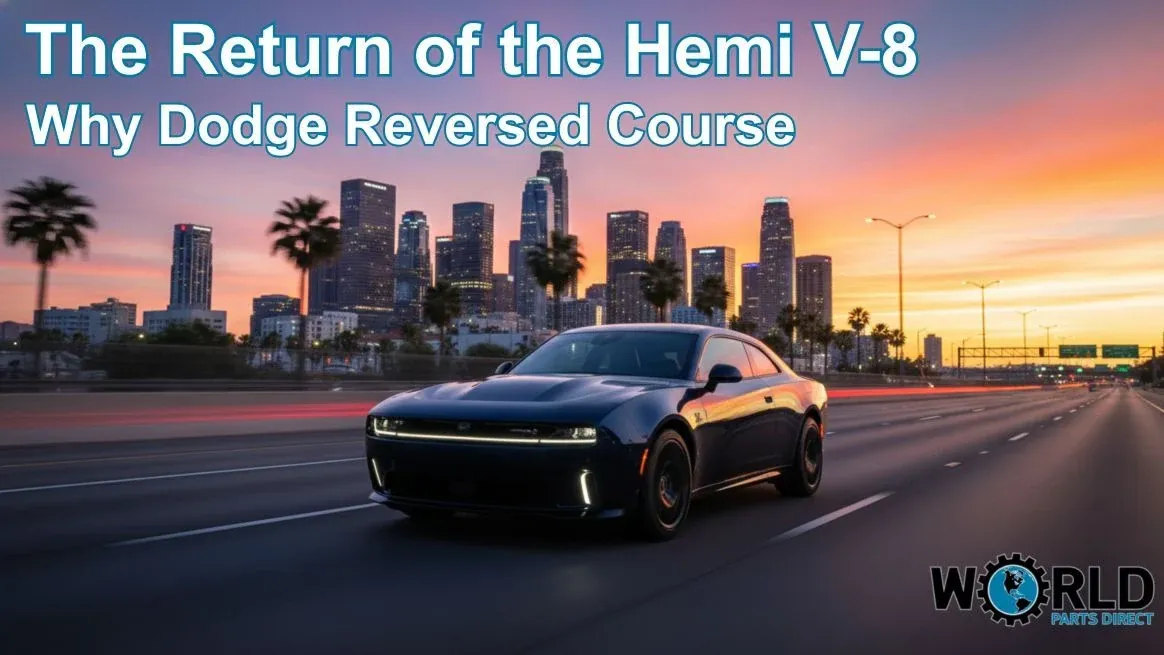
Hemi V-8 Returns: Dodge’s Next-Gen Charger Strategy Reversal
TL;DR
- Dodge reversed its V-8 exit because market response showed that brand equity, profitability, and credibility in the muscle segment remain tightly linked to Hemi V-8 performance.
- The STLA Large platform enabled the pivot by supporting EV, twin-turbo inline-six, and V-8 powertrains within a modular vehicle architecture.
- This is part of a broader ICE vs EV transition strategy shift: heritage performance brands are choosing sequencing and powertrain stratification instead of forced replacement. The Strategic Context: Why Dodge Tried to Move On From the V-8
Dodge initially moved away from V-8 engines to meet fleet emissions compliance, reduce platform complexity, and align with electrification mandates. However, market feedback revealed that for performance brands, regulatory optimization cannot replace cultural legitimacy, forcing a strategic reversal grounded in brand economics rather than ideology.
From a corporate standpoint, V-8s represent high-output but high-liability powertrains. They strengthen image and pricing power, but they also raise average fleet emissions and complicate global homologation. For a multi-brand group managing multiple regions, reducing powertrain variety can be a cost and compliance advantage.
Primary drivers behind the original V-8 phase-out
- Emissions standards that penalize low-volume, high-output engines
- Platform consolidation goals that reduce unique engine families
- Capital allocation shifting toward scalable electrified programs
- Consumer readiness assumptions that overestimated willingness to trade identity cues for new technology
Quick Comparison: Corporate logic vs brand reality
- Corporate logic: lower compliance risk, fewer engine families, easier global scalability
- Brand reality: muscle identity depends on sound, torque delivery, and recognition that performance numbers alone do not replace
The gap was not that modern powertrains underperformed. The gap was that a performance brand’s credibility is a business asset, and losing it can suppress demand even when specifications look competitive.
The Eighth-Generation Charger: A Platform Designed for Optionality
The eighth-generation Charger exists because Dodge needed flexibility, not certainty, in its powertrain future. The vehicle was engineered around choice, using an architecture capable of supporting EVs, turbocharged engines, and V-8s without committing exclusively to any single outcome.
That flexibility comes from the STLA Large platform, a multi-energy foundation intended to reduce strategic risk. Rather than forcing a one-way transition, a modular vehicle architecture allows Dodge to adjust powertrain mix as regulations, incentives, and demand signals change.
What multi-energy platform design enables
- Longitudinal compatibility for ICE and hybrid configurations
- Structural capacity for high-torque drivetrains
- Thermal management flexibility across ICE, hybrid, and EV loads
- Packaging optionality that avoids a single-path engineering dead end
Pros vs cons: Multi-energy platform strategy
- Pros: reduces development risk, supports staggered rollouts, preserves buyer choice
- Cons: higher upfront complexity, potential packaging compromises, slower optimization for one drivetrain
For the Charger, optionality is not a vague marketing concept. It is a practical hedge against uncertainty, especially in a segment where the emotional product promise matters as much as propulsion type.
The Hurricane Inline-Six Experiment: Technically Sound, Culturally Fragile
The Hurricane I6 approach struggled not because it lacked output, but because it lacked cultural legitimacy within Dodge’s muscle narrative. It can deliver strong horsepower and torque with better efficiency, yet it disrupted the cues many buyers use to identify a Charger as a muscle car.
The modern twin-turbo inline-six blueprint is attractive from an engineering standpoint: strong torque curves, improved thermal efficiency, and better emissions per unit of power. Those advantages are real and relevant under fleet emissions compliance pressure.
What the inline-six does well
- Power density: strong output from smaller displacement
- Torque delivery: broad, usable torque across the rev range
- Efficiency: improved emissions profile compared to legacy V-8 configurations
- Scalability: easier to deploy across multiple vehicles and markets
Quick Comparison: Twin-turbo inline-six vs V-8 in a muscle context
- Inline-six: compliance-efficient, technically modern, strong real-world torque
- V-8: immediate recognition, acoustic identity, and perceived mechanical presence tied to performance brand equity
The lesson is specific: performance parity does not equal identity parity. For a muscle nameplate, the drivetrain is not only propulsion; it is part of the product’s meaning and the buyer’s reason to care.
Consumer Response as Market Signal, Not Noise
Dodge reversed course because the response from the enthusiast market functioned as a measurable demand signal, not temporary outrage. The feedback highlighted a gap between what compliance frameworks prioritize and what muscle buyers reward with attention, loyalty, and purchases.
Unlike mainstream segments, Dodge’s performance audience is unusually consistent in preferences over time. When the V-8 promise weakened, the signal appeared as persistent negative sentiment and reduced excitement around product messaging, even when objective performance claims remained strong.
Indicators that the market signal was durable
- Persistence: sustained negativity rather than a short cycle
- Consistency: similar conclusions across platforms and communities
- Owner relevance: input from existing buyers and repeat customers
- Disengagement risk: apathy is more damaging than criticism
For a halo product, demand depends on identity and anticipation. When buyers stop debating and start ignoring, brand relevance becomes the constraint, not horsepower.
The Return of the Hemi V-8: What Changed Internally
The Hemi returned because Dodge recalculated risk and concluded that abandoning the V-8 posed a larger long-term threat than keeping it. The reversal reflects margin structure, credibility preservation, and practical feasibility, not nostalgia.
Performance trims have historically carried outsized profit per unit. That profitability can fund broader transition work while preserving a nameplate’s cultural role. In that sense, retaining V-8 options can support an ICE vs EV transition strategy by maintaining pricing power during a multi-year shift.
What made the reversal feasible
- Manufacturing and supplier familiarity with the Hemi ecosystem
- Trim-based emissions management that protects fleet averages
- Platform optionality that reduces packaging risk
- Brand economics showing that credibility supports demand and margin
Counter-intuitive takeaway
Offering V-8s can reduce strategic risk by sustaining profitability and performance brand equity, while allowing electrification to expand as a parallel path instead of a forced substitute.
The Drag Pak Proof Point: Engineering Reality vs Online Skepticism
The Charger Drag Pak mattered because it demonstrated that a modern Charger platform could physically support a high-output Hemi configuration. It shifted the debate from speculation about feasibility to a clearer question about product sequencing and intent.
Halo programs can function as engineering validation, not just brand theater. They show what packaging, cooling, and structural integration can support when the objective is proof rather than broad-market compromise.
What a proof-point program demonstrates
- Packaging: engine bay compatibility and integration pathways
- Thermal capability: cooling demands under sustained load
- Structural readiness: drivetrain torque and chassis demands
- Confidence signal: internal belief that the configuration is viable
In practice, the proof-point reframed public assumptions: the barrier was less about physics and more about timing, product planning, and compliance strategy.
Trim Strategy and Powertrain Hierarchy Going Forward
Dodge’s V-8 return is not a blanket rollback; it is a tiered strategy built on powertrain stratification. The Charger can align entry trims with efficiency goals while reserving V-8 options for performance trims that drive perception and margin.
This approach treats powertrains as role-specific tools. Lower trims can emphasize efficiency and scalability, while halo trims protect brand identity. Importantly, V-8s do not need to dominate sales volume to dominate perception.
How stratification can balance constraints
- Lower trims: reduce average emissions exposure
- Performance trims: protect identity and pricing power
- Limited variants: concentrate demand without overwhelming fleet math
- Mixed portfolio: keeps options open as incentives and rules change
Because compliance is often managed through averages, a focused mix can preserve icons while controlling the impact on the broader fleet.
What This Means for the Muscle Car Segment
Dodge’s reversal signals that the muscle car segment is not following a single linear path. Heritage performance categories are redefining their boundaries, proving that electrification strategies must be integrated without erasing the traits buyers use to identify the product.
Muscle cars are symbolic products. They are purchased as identity statements as much as transportation. That makes the category unusually sensitive to removing sensory cues, even when replacements perform well on a spreadsheet.
Broader implications
- More mixed drivetrains: coexistence becomes the norm in niche segments
- Greater emphasis on credibility: brand trust becomes a measurable constraint
- Sequencing electrification: additive adoption outperforms forced replacement
- Platform optionality: multi-energy architectures become a strategic hedge
The takeaway is not that EV performance cannot succeed. It is that heritage segments require asymmetric strategies where credibility leads and compliance is engineered around it.
FAQ: Dodge Charger V-8 Return
Why did Dodge bring back the Hemi V-8?
Because market response showed that removing the V-8 weakened credibility and demand signals in a segment where performance brand equity directly supports pricing power and long-term interest.
Is Dodge abandoning EVs with the new Charger?
No. The Charger’s platform approach supports EV and ICE options, reflecting a flexible ICE vs EV transition strategy rather than a single-path commitment.
Can one platform support both EVs and V-8s long term?
Yes. A modular vehicle architecture can accommodate different drivetrains by designing common structures and variant-specific packaging around them, preserving optionality as rules and demand change.
Will emissions regulations eventually eliminate V-8 Chargers?
Not automatically. Manufacturers can manage fleet emissions compliance with trim mix, production volume, and portfolio balancing, allowing limited V-8 offerings to remain viable.
What does this mean for enthusiasts?
It indicates Dodge is treating enthusiast demand as a strategic input rather than a transitional obstacle, which helps preserve credibility and product relevance.
Conclusion: A Case Study in Strategic Recalibration
Dodge’s return to the Hemi V-8 is a correction grounded in market reality, not a rejection of progress. The company learned that technological readiness does not guarantee cultural acceptance, especially in segments where identity and emotion function as economic value.
The eighth-generation Charger illustrates a more resilient approach: use platform optionality, apply powertrain stratification, and sequence change rather than forcing replacement. That strategy preserves credibility while keeping regulatory doors open.
For heritage performance brands, the durable path forward is not erasing the past. It is integrating it intelligently within a flexible architecture that can adapt to policy shifts and buyer demand.

About World Parts Direct
World Parts Direct is your go-to source for genuine OEM parts for GM and MOPAR vehicles. We make it easy to order factory-original parts online — shipped fast, accurately, and backed by real human support.
Every item we sell comes brand new in the manufacturer’s original packaging. Whether you’re handling routine maintenance, collision repair, or a full restoration, our parts professionals provide VIN-verified fitment support to ensure you get exactly what you need.
Serving drivers and repair shops worldwide, we proudly support brands like Chevrolet, GMC, Cadillac, Buick, Dodge, Chrysler, Jeep, and Ram. Shop confidently at WorldPartsDirect.com.