
GM and Mopar Maintenance Schedule: Service Intervals, OEM Parts, and What to Watch For
GM and Mopar Maintenance Schedule: Service Intervals, OEM Parts, and What to Watch For
Most vehicle problems don't happen without warning. They build slowly, quietly, over thousands of miles of deferred maintenance. A coolant system that hasn't been serviced in 60,000 miles. Spark plugs that were due for replacement two oil changes ago. A cabin air filter so clogged it's barely doing its job.
The good news is that most of it is preventable. GM and Mopar vehicles are built to last, but they're also built with specific service intervals in mind. When you follow those intervals with the right parts, the vehicle holds up the way it was designed to. When you don't, you're paying for it eventually, usually at the worst possible time.
This guide breaks down the core maintenance schedule for GM and Mopar vehicles: what needs attention, when it needs it, and what to look for before something becomes a real problem.
TL;DR: Key Takeaways
- Oil and filter should be changed every 5,000 to 7,500 miles on most GM vehicles and every 6,000 to 8,000 miles on most Mopar vehicles.
- Spark plugs on iridium or platinum equipped engines typically last 60,000 to 100,000 miles, but waiting for a misfire means you've already waited too long.
- Coolant flushes are due every 30,000 miles on Mopar vehicles and up to 150,000 miles on GM vehicles running Dex-Cool under ideal conditions.
- Brake pads should be inspected every 20,000 to 25,000 miles and replaced between 30,000 and 70,000 miles depending on driving habits.
- Air, cabin, and fuel filters are the most skipped items on the schedule, yet they directly affect engine performance and fuel economy.
- OEM parts are built to exact tolerances for your specific vehicle. Aftermarket alternatives may fit, but they don't always perform or last the same way.
Oil and Filter: The Non-Negotiable
Oil changes are the most routine item on any maintenance schedule, but they're worth taking seriously. Modern GM vehicles equipped with the Oil Life Monitoring System will alert you when it's time, typically somewhere between 5,000 and 7,500 miles depending on how the vehicle is driven. Mopar-equipped vehicles follow similar intervals, with Chrysler, Dodge, Jeep, and Ram models generally recommending oil changes every 6,000 to 8,000 miles under normal driving conditions.
The filter matters just as much as the oil. An OEM oil filter is engineered to your specific engine's flow rate and pressure requirements. Aftermarket filters vary widely in quality, and in a high-performance engine, that variation shows up over time. Running the right oil filter is one of the cheaper ways to protect one of your most expensive components.
Spark Plugs and Ignition Components: Don't Wait for a Misfire
Spark plugs are a maintenance item that most drivers ignore until there's a noticeable problem. By that point, the engine has already been running less efficiently for longer than it should. GM vehicles equipped with iridium or platinum plugs generally run on a 100,000-mile replacement interval. Mopar vehicles, depending on the engine, typically call for replacement between 30,000 and 100,000 miles.
The issue with waiting too long is that worn plugs don't just hurt fuel economy. They put additional stress on ignition coils, which are considerably more expensive to replace. Staying ahead of the interval keeps the whole system healthy.
If your vehicle is showing rough idle, harder starts, or a check engine light related to misfires, ignition components are the first place to look. OEM plugs and coils are matched to your engine's firing specs, which matters more than most people realize on modern direct-injection engines.
Coolant and Cooling System: The System Most People Ignore
Coolant doesn't last forever. Over time it becomes acidic, and acidic coolant breaks down the very components it's supposed to protect: water pumps, radiators, heater cores, and gaskets. GM's Dex-Cool coolant is designed for a 150,000-mile or five-year service interval under ideal conditions, but real-world driving conditions shorten that. Mopar recommends coolant service every 30,000 miles or every five years, whichever comes first.
A cooling system failure is rarely just one part. When a hose blows or a water pump gives out, it often means the coolant hasn't been serviced in too long. Catching it early with a proper flush and OEM-spec coolant components is far cheaper than dealing with an overheated engine on the side of the road.
Browse cooling system parts including thermostats, water pumps, hoses, and radiator caps built to GM and Mopar specifications.
Brakes: Service by Feel and by Mileage
Brake service intervals are less predictable than most because they depend heavily on driving habits. City driving with frequent stops wears pads significantly faster than highway miles. That said, a general rule of thumb for most GM and Mopar vehicles is to inspect brake pads every 20,000 to 25,000 miles and plan for replacement somewhere between 30,000 and 70,000 miles depending on use.
What to listen for: squealing indicates the wear indicators are contacting the rotor. Grinding means the pads are gone and metal is on metal. Either way, you're past due. Vibration or pulsing under braking usually points to warped rotors.
OEM brake components are engineered to the specific weight and stopping characteristics of your vehicle. GM and Mopar trucks and SUVs in particular carry significant loads, and the braking system is calibrated accordingly. Swapping in non-OEM pads or rotors on a heavy-duty vehicle is a compromise you feel in stopping distance.
Find OEM brake pads, rotors, and calipers for GM and Mopar vehicles.
Filters: Air, Cabin, and Fuel
Filters are the maintenance items most likely to get skipped because the consequences are gradual rather than sudden. But they matter.
Engine air filter: Most GM and Mopar vehicles call for replacement every 15,000 to 30,000 miles. A clogged air filter restricts airflow to the engine, hurts fuel economy, and in severe cases causes rough running. It's one of the simplest and cheapest maintenance items on the schedule.
Cabin air filter: Often overlooked entirely, the cabin filter affects both air quality inside the vehicle and HVAC system efficiency. Replacement is typically recommended every 15,000 to 25,000 miles. If you've noticed reduced airflow from your vents or more dust inside the cabin, the filter is the first thing to check.
Fuel filter: Fuel filter service intervals vary more widely. Some modern GM and Mopar vehicles have filters integrated into the fuel pump assembly, which extends the service interval significantly. For vehicles with serviceable inline filters, replacement every 30,000 miles is a reasonable baseline. A clogged fuel filter starves the engine under load and puts unnecessary strain on the fuel pump.
Shop air, cabin, and fuel filters for your specific GM or Mopar vehicle.
Gaskets and Seals: The Parts You Notice When They Fail
Gaskets and seals don't show up on a standard mileage-based schedule the way spark plugs or filters do. They're more conditional: age, heat cycles, coolant quality, and oil maintenance history all affect how long they last. But when they go, you know it.
Common failure points on GM vehicles include intake manifold gaskets and valve cover gaskets. On Mopar vehicles, particularly older Hemi engines, head gaskets and oil pan gaskets are areas worth watching. The signs are usually the same: oil or coolant seeping where it shouldn't be, a burning smell after the engine warms up, or unexplained fluid loss.
The best way to extend gasket life is to stay current on coolant service and avoid letting the engine overheat. When replacement is necessary, OEM gaskets are made to the exact tolerances your engine was assembled with. An improperly seating aftermarket gasket on a high-mileage engine is a problem you don't want to repeat twice.
Find OEM gaskets and seals for GM and Mopar applications.
Transmission Fluid: The Service Most Owners Skip Entirely
Transmission fluid is one of the most neglected items on any maintenance schedule, which is why transmission repairs are among the most expensive. Both GM and Mopar have specific fluid recommendations that differ significantly from one platform to the next, and using the wrong fluid is just as damaging as skipping the service altogether.
GM vehicles with automatic transmissions generally call for a fluid exchange every 45,000 miles under severe driving conditions — towing, frequent stop-and-go, hilly terrain — and every 97,000 miles under normal conditions. Mopar vehicles with the ZF-sourced 8-speed automatic, found in a wide range of Dodge, Jeep, and Ram models, typically specify fluid changes every 40,000 to 60,000 miles depending on use.
Manual transmissions have their own service intervals, generally every 30,000 to 60,000 miles. The symptoms of degraded transmission fluid are easy to dismiss early on: slightly delayed shifts, a vague feel in the gears, minor hesitation under load. By the time it becomes obvious, the damage is usually already done.
OEM transmission fluid is formulated specifically for the friction characteristics and tolerances of your transmission. Substituting a universal fluid to save a few dollars on a $3,000 to $8,000 component is a tradeoff that rarely makes sense.
Tire Rotation: The Cheapest Thing You Can Do for Long-Term Wear
Tires wear unevenly by design. Front tires handle steering loads and tend to wear faster on the outer edges. Rear tires carry drive torque on rear-wheel and all-wheel drive vehicles and wear differently depending on the powertrain layout. Without regular rotation, one set of tires wears out significantly faster than it should, and the vehicle's handling balance drifts over time.
The standard interval for both GM and Mopar vehicles is every 5,000 to 7,500 miles, which conveniently lines up with most oil change schedules. Doing both at the same time makes it easy to stay consistent without adding extra service appointments.
Uneven tire wear also masks other issues. A vehicle that hasn't been rotated in 20,000 miles may show wear patterns that point to alignment problems, suspension wear, or improper inflation that would have been caught earlier with regular inspections. Rotation isn't just about extending tire life — it's a cheap, regular checkup on everything underneath the vehicle.
A Simple Reference Schedule
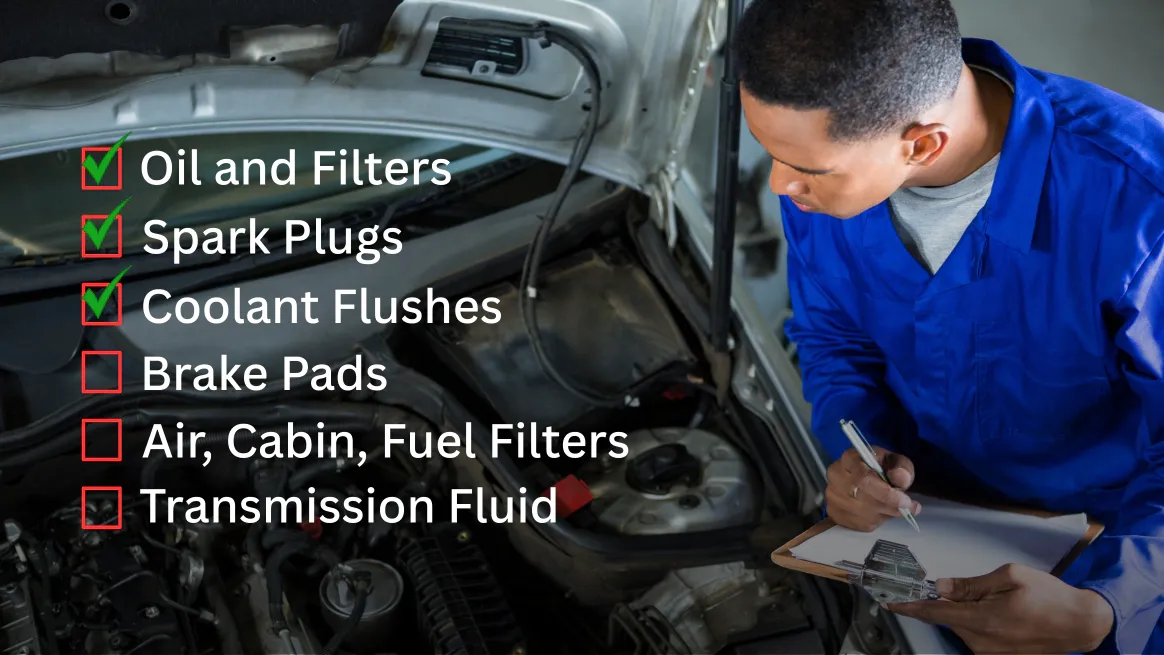
Every vehicle is different, and your owner's manual is always the authoritative source. But as a general framework for most GM and Mopar vehicles:
- Every 5,000 to 7,500 miles: Oil and filter, tire rotation
- Every 15,000 to 30,000 miles: Engine air filter, cabin air filter, brake inspection
- Every 30,000 miles: Fuel filter (where serviceable), coolant inspection
- Every 30,000 to 60,000 miles: Transmission fluid (severe use or Mopar 8-speed)
- Every 30,000 to 70,000 miles: Brake pads (depending on use)
- Every 30,000 to 150,000 miles: Coolant flush (per manufacturer spec)
- Every 30,000 to 100,000 miles: Spark plugs (depending on plug type and engine)
- Every 45,000 to 97,000 miles: Transmission fluid (GM, depending on use)
- As needed: Gaskets, seals, ignition coils
OEM Parts Are Part of the Schedule
Staying on schedule matters. But so does what you put in the vehicle when you do. GM Genuine Parts, ACDelco, and Mopar components are engineered specifically for the vehicles they go into. They're not close enough. They're exact.
Aftermarket parts vary, and on a vehicle still under warranty or one you're trying to keep running for another 100,000 miles, that variation adds up. The part that costs a little less at the counter can cost considerably more down the road if it doesn't hold up or causes secondary issues.
The best maintenance strategy is a simple one: know your intervals, use the right parts, and don't wait for symptoms. GM and Mopar vehicles are built with long service lives in mind. Most of the owners who get there without major repair bills aren't lucky — they're just consistent.
Frequently Asked Questions
How often should I change the oil on a GM vehicle?
Most modern GM vehicles equipped with the Oil Life Monitoring System will alert you when an oil change is needed, typically between 5,000 and 7,500 miles under normal driving conditions. Severe use — frequent towing, extended idling, extreme temperatures — shortens that interval. Always follow the oil life monitor rather than a fixed mileage if your vehicle has one.
How often should I change the oil on a Mopar vehicle?
Chrysler, Dodge, Jeep, and Ram vehicles generally recommend oil changes every 6,000 to 8,000 miles under normal driving conditions. Severe driving conditions such as towing, off-road use, or stop-and-go city driving may warrant more frequent changes. Check your owner's manual for the specific interval for your engine and model year.
What happens if you don't flush coolant on schedule?
Over time, coolant becomes acidic and begins to break down the components it's supposed to protect — water pumps, radiators, heater cores, and head gaskets. On GM vehicles running Dex-Cool, contamination or mixing with incompatible coolants can accelerate this process. On Mopar vehicles, neglecting the 30,000-mile flush interval leaves aging fluid circulating through systems that depend on its corrosion inhibitors remaining active. The result is usually a more expensive repair than the flush would have cost.
How do I know when my brake pads need to be replaced?
Squealing during normal braking is usually the wear indicators making contact with the rotor — that's the built-in warning. Grinding means the pads are gone entirely and metal is contacting metal. Vibration or pulsing through the brake pedal typically points to warped rotors. Any of these symptoms mean service is overdue. For GM and Mopar trucks and SUVs, brake inspections every 20,000 to 25,000 miles help catch wear before the audible warnings start.
Is OEM transmission fluid really necessary, or will any ATF work?
For most GM and Mopar transmissions, OEM-specified fluid matters more than people realize. GM's DEXRON series and Mopar's ATF+4 and ZF-spec fluids are formulated for the specific friction characteristics of each transmission. Using a universal ATF may work short-term but can cause shift quality issues and accelerated wear over time. Given what a transmission rebuild or replacement costs, using the correct fluid is one of the least expensive ways to protect a major component.
Do I really need to rotate tires if they look fine?
Yes. Uneven wear develops gradually and isn't always visible until it's advanced. Front tires on front-wheel drive vehicles carry both steering and drive loads, which causes them to wear significantly faster than rears. Regular rotation every 5,000 to 7,500 miles evens out that wear pattern, extends the life of the full set, and gives a technician a regular look at brake and suspension components in the process.

About World Parts Direct
World Parts Direct is an authorized GM Genuine Parts, ACDelco, and Mopar Parts vendor based in Garland, TX. We sell genuine OEM parts for Chevrolet, GMC, Cadillac, Buick, Dodge, Chrysler, Jeep, and Ram vehicles — shipped fast, in original manufacturer packaging, with VIN-verified fitment support.
If you have questions about fitment or need help finding the right part before you order, reach us at [email protected] or 972-864-9777. Shop at WorldPartsDirect.com.