
Nürburgring Explained
Nürburgring Explained A Driver's Ultimate Guide
The Nürburgring explained in plain language is this: a vast motorsport complex in Germany’s Eifel mountains with two main tracks, the historic Nordschleife and the modern GP-Strecke, where you can drive during public sessions, book proper track days, or watch world-class endurance racing under the trees and mist. It is equal parts pilgrimage, proving ground, and public road.
Direct answer for voice search. Nürburgring explained for visitors: buy per-lap tickets for Touristenfahrten, drive a road-legal car under German road rules, overtake left only, expect closures and weather swings, and consider coaching or a specialist rental. For racers: enter licensed track days or series like NLS and the 24h, study flags, Code 60, and class rules.
TL;DR: The Nürburgring is a legendary motorsport complex in Germany featuring the historic Nordschleife and the modern GP-Strecke tracks. Visitors can experience driving on the Nordschleife during public sessions with road-legal cars, while racers participate in official events like the 24-hour endurance race.
Key tips include following German road rules, anticipating weather changes, and considering coaching or specialist rentals for safety and performance. It’s a unique blend of public road and racing circuit that challenges drivers of all levels.
Nürburgring overview: what to know before you go
About the Nürburgring and its location
The Nürburgring sits around the village and medieval castle of Nürburg in Rhineland-Palatinate, Germany. It can host roughly 150,000 people on a busy weekend, and it consists of a 20.832 km Nordschleife “North Loop” wrapped through the forest plus a 5.148 km Grand Prix circuit from the 1980s. Cologne/Bonn Airport is about an hour by car, and Frankfurt-Hahn is roughly an hour and a half in good conditions. Driving is the practical way to get there. Public transport is limited.
Two tracks share the spotlight. The Nordschleife is the famous rollercoaster with more than 300 meters of elevation change and well over one hundred bends, some built on concrete banking that will rattle your forearms. The GP-Strecke is a safer, modern layout with big runoffs and familiar FIA features. The two can be joined for marquee events such as the 24 Hours.
Who should drive it and who should wait
Anyone with a valid license and a road-legal, motorway-capable vehicle can join Touristenfahrten, the public sessions. That openness is the magic and the risk. Newer drivers who know the rules, book an instructor, and choose a modest car usually have a better day than overconfident hands who jump into a supercar. “Hot hatch first” is a smart rule of thumb. Specialist firms near the gates rent suitable cars, offer safety briefings, and can ride along.
Those still working on basic car control may be happier in a Ring “taxi” passenger lap or spectating from Brünnchen before trying a steering wheel. Track days are better than public sessions if you crave space, structured instruction, and consistent etiquette. They run fewer cars, require helmets, and allow continuous lapping, but cost more and sell out early.
First-time expectations and common mistakes
- Don’t chase lap times during public sessions. Timing is forbidden and can jeopardize insurance. Focus on line-of-sight driving and traffic awareness.
- Expect closures. Accidents and fluid spills are common; towing and barrier repair bills fall on the responsible driver. Build patience into your schedule.
- Weather swings are part of the experience. One lap can deliver sun at Hatzenbach and drizzle at Pflanzgarten. Respect damp shade and painted surfaces.
- Start slow on a forgiving car and tire. The circuit punishes late braking and early throttle more than most. Save upgraded tires until you understand the surface.
A quick micro-moment. Many visitors recall the first run up Döttinger Höhe, windows cracked, the sound of a GT car thundering past like distant thunder, the forest smell sweet and damp. That sensory mix turns casual fans into repeat pilgrims.
Nürburgring history and meaning
Nürburgring meaning and German terms (Erklärung)
“Nürburgring” translates to the “ring of Nürburg Castle,” a literal nod to the medieval fortress on the hill above the track. Common terms help: Nordschleife is the North Loop, GP-Strecke is the Grand Prix course, Touristenfahrten indicates public lapping, and Gesamtstrecke refers to the combined layout. The nickname “Green Hell,” coined by Jackie Stewart after a foggy, wet Grand Prix win, fits the place’s dense forest, fickle climate, and relentless nature.
Key milestones from 1927 to today
- 1927. Track opens with North and South loops, plus a short Betonschleife near the pits. Major races soon focus on the Nordschleife.
- Post-war return. Formula One arrives in 1951, while sportscar enduros like the 1000 km and the 24 Hours grow the circuit’s legend.
- 1967–1971. Safety tweaks add the Hohenrain chicane, Armco barriers, and smoother jumps. The Ring remains brutally demanding.
- 1976. Niki Lauda’s fiery crash underscores the rescue and logistics limits of a 22+ km loop. F1 leaves for Hockenheim the following year.
- 1984. A new GP-Strecke opens on the old start-finish plateau. The Nordschleife is shortened to 20.832 km and continues hosting racing and public access.
- 2002–2003. The Mercedes-Arena and a revised final chicane reshape the GP track.
- 2015–2016. After a spectator fatality at Flugplatz in a GT3 race, slow zones and resurfacing reduce flight-inducing crests.
- 2020. Formula One returns for the Eifel Grand Prix on the GP track.
- 2025. The circuit announces that motorcycles will be excluded from Touristenfahrten public laps starting with the new season. As always, check current rules before traveling.
Safety evolution and the modern era
Changes balanced heritage with reality. Armco arrived, sightlines improved, grass verges widened, and signature jumps smoothed in places. The Nordschleife still runs through forest with limited runoff, so modern series use Code 60 and speed-limited slow zones for incident control. The Flugplatz crest and surrounding areas were reworked after 2015. Today, the track also serves as an industry test hub, reserved many weeks each year for development.
Understanding Nürburgring track layout and configurations
Nordschleife basics and iconic sections
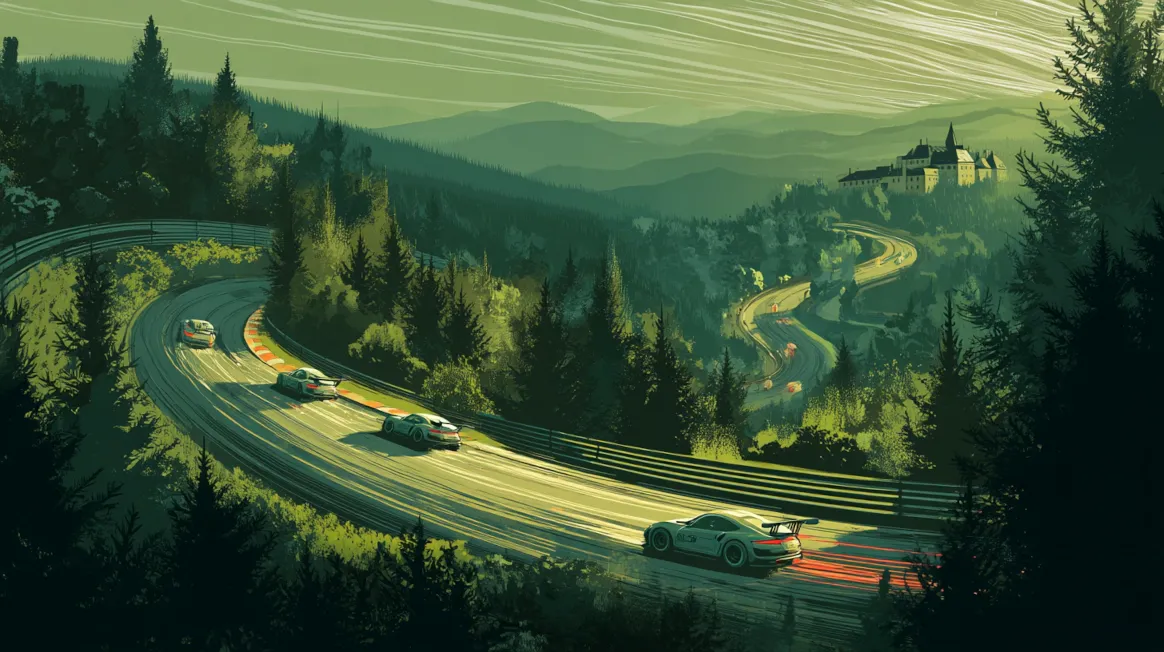
The Nordschleife runs clockwise for 20.832 km with 154 turns in current racing configuration, climbing and falling more than 300 meters. It blends fast commitment zones and low-speed technical puzzles. Flight and compression, camber and shade, concrete and asphalt patches make laps feel alive.
- Flugplatz and Schwedenkreuz. Flat-out bravery over crest and into a rapid left that demands precise placement. Parts were resurfaced to curb airborne moments.
- Fuchsröhre and Adenauer Forst. A plunging straight that compresses suspension before a blind, tricky sequence that destroys rushed braking points.
- Bergwerk. The corner that sets your run up Kesselchen. A small mistake here cascades into a slow sector time or worse.
- Karussell. The famous concrete-banked bowl that batters the wrists and rewards commitment. It is followed by a steep haul to Hohe Acht.
- Brünnchen and Pflanzgarten. Spectator favorites with layered crests and direction changes that punish hesitation and reward rhythm.
GP-Strecke and combined 24h/NLS layout
The GP-Strecke measures about 5.148 km in its common long form, with 15 turns and modern amenities. It hosts everything from DTM to historic festivals, and it is used for most international series that require Grade 1 safety. The 24 Hours and the NLS endurance races join a GP subset to the Nordschleife, yielding a ~25.378 km lap without the Mercedes-Arena.
Elevation, surface, and grip changes
Grip changes lap to lap with temperature, traffic, and cloud cover. The Karussell’s concrete bites differently than the asphalt you exit onto. Forest shade keeps sections damp long after rain ends. Drainage dips collect gravel and rubber.
Expect a living road, not a uniform racetrack. This is why learning in small chunks works better than memorizing a single “perfect” line.
Nürburgring explained: how the track works for visitors and racers
Touristenfahrten public sessions explained
Touristenfahrten are public driving sessions. The Nordschleife is operated as a one-way toll road with German traffic law in force. You buy per-lap tickets, tap through access gates near the main straight, complete a lap, then exit via the gantry. Overtake left only, treat flags like road warnings, and leave space. There is no timing and no racing. The season typically runs from mid-March to mid-November with frequent evening openings.
Practical notes. Per-lap prices vary by day. Expect closures and queues. You pay for barrier damage and recovery if you crash or break down, and you must report incidents. Insurance coverage is often limited for TF, so read your policy. Specialist rental fleets include helmets when required and will brief you on rules.
Track days, licenses, and coaching options
Private track days reduce traffic, require pre-registration, include a safety briefing, and often run open pit lane. Entry fees are typically a full-day price rather than per lap, with instruction strongly encouraged. Some organizers allow race cars; others keep it street-car only.
Nordschleife racing licenses and class permits exist for series competition, but newcomers can safely skip that rabbit hole until fundamentals are in place.
Coaching accelerates learning. In-car instruction during TF focuses on safety and traffic management rather than chasing speed, while track days can offer full programs with lead-follow and section work. The fastest gains usually come from line-of-sight discipline, braking planning, and leaving margin at crests and compressions.
Bridge-to-Gantry timing and lap records
Because TF laps must pass a ticket gate, many enthusiasts discuss “Bridge-to-Gantry” times that start near the first bridge after the access gates and end at the final gantry before the exit. It is an informal habit, not a sanctioned measure, and timing during public sessions remains against the rules.
As context for the track’s pace: Stefan Bellof set an astonishing 6:11.13 race lap in a Porsche 956 on the 20.832 km Nordschleife configuration in 1983, and in 2018 the Porsche 919 Hybrid Evo achieved a 5:19.546 demonstration lap on a slightly longer variant. Production-car records change often; treat any claim with healthy skepticism and note which layout was used.
Nürburgring rules, etiquette, and safety
Vehicle and equipment requirements
- Touristenfahrten require a road-legal, highway-capable vehicle. Slick tires, loose parts, and leaks are non-starters. Track-only race cars are not permitted during TF. Noise is monitored around 130 dB.
- Drivers need a valid license. Passengers must meet minimum age rules, typically 16 for TF cars. Taxi laps and organizers may set higher limits.
- Helmets are mandatory on most organized track days and in some rentals, but not generally required during TF in standard cars. Check organizer guidance.
Flags, Code 60, and on-track etiquette
During TF, standard German road rules apply rather than full race marshalling, but flag points still warn of incidents. Yellow means slow, be ready to stop. Double yellow means a serious hazard. At closures, follow staff signals and exit calmly.
During races and many track days, Code 60 may be used to neutralize sections to 60 km/h while recovery happens. Keep right, overtake left, signal your intentions early, and never stop on track unless directed.
Insurance, liability, and damage costs
Responsibility sits with the driver. If you damage barriers or the surface, expect to pay for parts and labor as well as time for personnel and closures. If you need a tow, recovery is chargeable per kilometer. Standard rental car contracts often ban the Ring, and some personal policies exclude TF or limit cover to third-party. Read the fine print, ask your rental company to spell out excess and deposit rules, and consider travel medical coverage when visiting from abroad.
Planning your trip: costs, tickets, and logistics
When to visit and weather considerations
The calendar is usually posted around February for the season beginning mid-March. Shoulder months in spring and late autumn can bring thinner crowds and kinder costs, but cool track temperatures and fast weather changes. Summer can be warm and busy, especially around holidays and major events. Mid-week evenings often feel calmer. Fog can shut the track even on dry days. Rain can be a gift if you treat it as a classroom for smooth inputs and patience.
Tickets, rentals, and insurance choices
Touristenfahrten tickets are bought per lap through the official system or app, then scanned at the gate. Track days sell through specific organizers and include their own rules and briefings. Specialist rental firms near the Nordschleife provide cars set up for the circuit and offer guidance on which model fits your level, with pricing from modest hatchbacks to GT machinery. Normal airport rentals are often contractually banned from the Nordschleife and tracked by GPS.
For peace of mind, pair TF plans with health coverage that includes foreign incidents. Dedicated “Ring insurance” products exist in some markets, but the terms vary widely. What always helps is a conservative approach on lap one and the willingness to build speed slowly over several days rather than one frantic evening.
Travel, lodging, and local transport
- Fly to Cologne/Bonn or Frankfurt-Hahn, rent a car, and drive to Nürburg. Keep an eye on speed limits and cameras on the Autobahn when posted.
- Stay in Nürburg for walking access to the GP complex or in Adenau for wider dining and services. Rooms sell out quickly around big race weekends.
- Expect limited public transport. Taxis are workable but can be scarce late. Self-drive is best.
| Option | Cost model | Traffic level |
|---|---|---|
| Touristenfahrten | Per lap ticket | Highly variable |
| Track day | Day fee | Lower, more consistent |
| NLS/24h spectating | Event ticket | N/A |
Car preparation and driver development for the Nordschleife
Brakes, tires, fluids, and cooling
- Brakes. Fresh high-quality fluid, adequate pad thickness, and a check for soft pedal under heat. Long descents punish marginal systems.
- Tires. Road-legal tires in good condition with healthy tread depth. Avoid old “track” tires that heat-cycle out and skate when damp.
- Fluids and torque. Check oil level and coolant, torque wheel bolts, and inspect for leaks. A small seep becomes a big hazard at Fuchsröhre.
- Fuel. Start laps with enough range for a closure. Running dry far from an exit is an expensive tow.
Simulators, coaching, and learning resources
Quality sim laps in Assetto Corsa or iRacing help with visual memory and rough rhythm. They do not replicate blind crests, mixed grip, and traffic, so treat them as orientation only. Break the track into sections and review notes between runs. Driver61’s free long-form guide and reputable coaching programs give a structure that pays off quickly on such a complex circuit.
Wet, cold, and mixed-conditions strategy
Assume the worst grip in shaded woods and concrete patches. Beware standing water near curb exits and the oily center of the lane at low speed corners. Add a gear, smooth your hands, and brake early. Rain often reduces traffic, which helps first-timers find calm space to process what the car is telling them.
Why the Nürburgring is feared: risk factors explained
Blind crests, cambers, and elevation
You drive the Nordschleife partly by memory and partly by cues like tree lines and marshal posts. Blind crests hide tightening radii, off-camber surfaces, and surprise traffic. Elevation amplifies weight transfer, raising the stakes for brake release and steering timing. A small misread at Schwedenkreuz becomes a large moment quickly.
Limited runoff and barrier proximity
It is a narrow mountain road at heart. Armco lines much of the lap, with trees beyond it in many places. While safety work added verges and smoother surfaces, it remains closer to a tarmac rally stage than a modern stadium circuit. That character is why it is loved and why it demands respect every meter.
Traffic mix, speed gaps, and recovery zones
Public sessions mix everything from vans to very quick GT cars in the same lane. Track days still create speed deltas that challenge awareness. Neutralization uses flag points and slow zones more than walls and cranes. Your best tool is margin, not mirrors alone. If a fast car appears, lift and hold a predictable right line.
Nürburgring races and classes explained
Nürburgring Langstrecken Serie (NLS) explained
NLS, historically known as VLN, is a series of Saturday endurance races that anchor the Nordschleife calendar. It runs multiple hours per round on the combined circuit with a portion of the GP layout, drawing everything from near-stock touring cars to GT3 machinery. The grid stretches the definition of multi-class, which makes strategy and traffic management central to results.
24h Nürburgring race explained
The 24 Hours typically runs in May or June with more than 200 cars, a festival atmosphere, and fans camping at iconic corners. The lap uses the 25.378 km combined course, and the conditions will almost certainly change several times. Differences in car speed are enormous, which makes the closing rate discipline a defining driver skill in the night.
Nürburgring classes explained and BoP
Classes range from production-based categories to special “SP” groups. SP9 is the GT3 top tier, with Balance of Performance shaping pace. There are one-make cups and touring classes as well. For spectators, this alphabet soup matters less than the reality on track: a TCR car navigating a Karussell pass on a GT3 that pits next lap, all while marshals run a Code 60 two corners ahead.
Spectating, culture, and best viewing spots
Iconic spectator areas and access
- Brünnchen. Two right handers with a short straight and a hillside that fills with cameras. Expect plenty of “save or spin” moments.
- Pflanzgarten. High speed compressions and direction changes that separate tidy laps from lucky ones. The sounds are worth the walk.
- Karussell. Fewer seats, but a view that matches the postcards. Watch how pros drop in early and climb out onto the asphalt apex.
The GP paddock offers grandstands, food, and easy amenities. Paths and shuttle access vary by event, so grab a spectator map and bring sturdy shoes. Cell coverage can be patchy deep in the trees. Cash still speeds along queues at rural food stands.
Camping, paddock, and festival atmosphere
Part of the mystique is living trackside. The 24 Hours sees tents and grills from Hatzenbach to Pflanzgarten. Nights hum with diesel generators and dance music, then quiet when the fog sits low over the hedges. Off-calendar, the complex hosts the Rock am Ring music festival, karting, and the RingWerk museum for a rain break with the family.
Local food, shops, and car culture
Near the main entrance you will find Devil’s Diner, quick bites on paddock days, and beloved staples like Pistenklause in Nürburg. Adenau has pizzerias and bakeries for a quick refuel between sessions. Model-car and souvenir shops cluster near the GP boulevard. Even the gas stations sell Ring stickers and late-night bratwurst.
Nürburgring FAQ
How does the Nürburgring work?
For public laps, buy tickets, scan at the gate, drive one lap under road rules, and exit, then queue again if you want another. Overtake left only, heed flags, and expect closures. For track days, book in advance with stricter briefings and gear. Races use the combined course and full marshalling.
Why is the Nürburgring so feared?
Blind crests, camber changes, big elevation, limited runoff, and fast weather shifts make mistakes costly. Traffic mixes create speed gaps that stress decision-making. Even with safety work and slow zones, it remains a mountain road at heart, which is exactly why it is so captivating.
Why did F1 get banned from Nürburgring?
By the mid-1970s, the Nordschleife’s length and rescue logistics fell behind F1’s speed and TV demands. Niki Lauda’s 1976 crash highlighted medical response limits and weather variability. F1 moved to Hockenheim and then used the shorter GP-Strecke in later years, where it still occasionally returns.
What are the rules of the Nürburgring?
During Touristenfahrten, German road law applies. No timing or racing. Overtake left, yield predictably, and obey flags and staff. Report incidents. You will pay for barrier and surface damage you cause, as well as recovery. On track days and races, organizers add helmets, briefings, and series-specific conduct and safety rules.
Conclusion: final tips and next steps for your first lap
Here is the short take. Approach the Ring as you would a beautiful, moody mountain road shared with strangers. Arrive rested, rent the right car, leave time for closures, and build speed slowly. The reward is clarity of focus and a memory that grows richer the more you learn. Nürburgring explained or not, the only way it truly makes sense is with your hands on the wheel.
Step-by-step plan for a safe first visit
- Pick dates outside major events, favor mid-week evenings in spring or autumn, then check the official opening calendar. Outcome: fewer cars, more learning.
- Book a specialist rental matched to your experience, add a guide for the first laps, and confirm insurance terms. Outcome: right tool, fewer surprises.
- Reserve lodging in Nürburg or Adenau and plan to drive yourself. Outcome: simple access, flexibility if closures happen.
- Prepare basics: brake fluid, pad thickness, tire condition, torque, and fluids if bringing your own car. Outcome: reliability under heat.
- On arrival, walk a spectator area like Brünnchen to calibrate speed and lines. Outcome: a mental model before you’re in traffic.
- Buy a small lap bundle, drive the first lap at 70 percent, and ignore clocks. Outcome: margin to see flags, crests, and exits.
- Pause between laps for notes. Break the track into three sections and focus on one improvement per run. Outcome: structured progress.
- If rain appears, continue calmly at lower speed. Work on vision, brake release, and throttle smoothness. Outcome: skills that transfer to dry pace.
- End with a cool-down drive into Adenau for dinner rather than one last “hero” lap. Outcome: you leave wanting more, not needing repairs.
- Plan a return. The Nürburgring explained in words is only a sketch. The second trip is where it clicks. Outcome: safer speed and deeper enjoyment.
One last nudge. People often overestimate what they can do in one evening and underestimate what consistent, thoughtful laps deliver in a season. Treat the “Nürburgring explained” mindset as a compass, not a stopwatch, and the Green Hell repays you in spades.

About World Parts Direct
World Parts Direct is your go-to source for genuine OEM parts for GM and MOPAR vehicles. We make it easy to order factory-original parts online — shipped fast, accurately, and backed by real human support.
Every item we sell comes brand new in the manufacturer’s original packaging. Whether you’re handling routine maintenance, collision repair, or a full restoration, our parts professionals provide VIN-verified fitment support to ensure you get exactly what you need.
Serving drivers and repair shops worldwide, we proudly support brands like Chevrolet, GMC, Cadillac, Buick, Dodge, Chrysler, Jeep, and Ram. Shop confidently at WorldPartsDirect.com.