
Dodge Charger vs Challenger: Which Is Easier to Maintain and Upgrade (2008–2023)
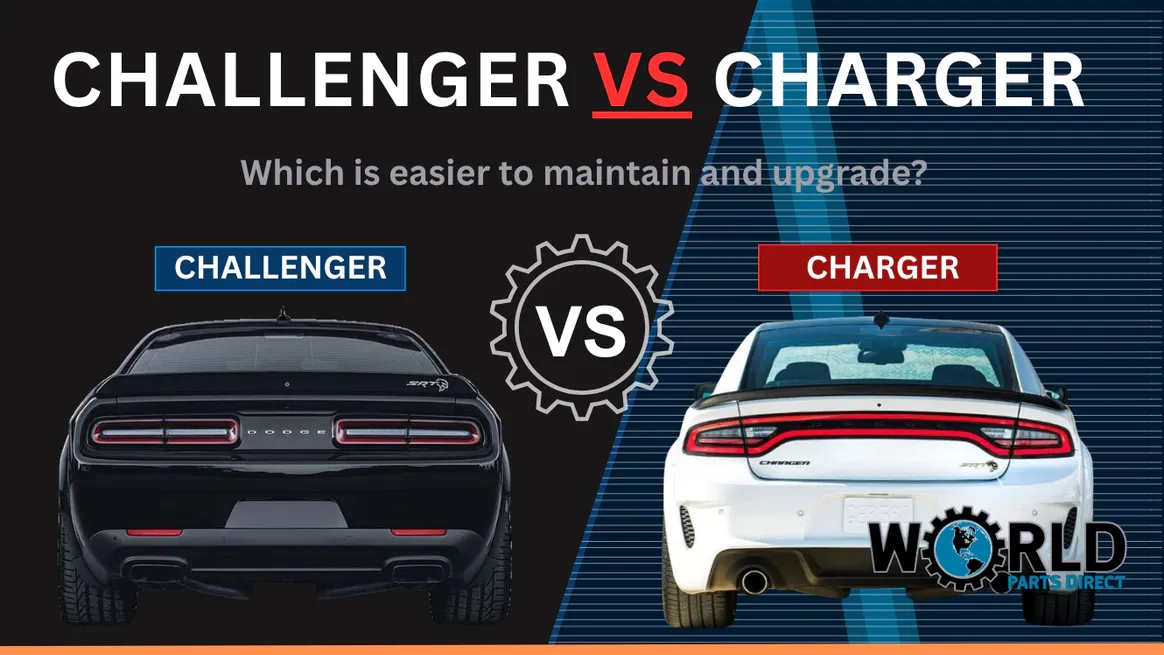
Dodge Charger vs Challenger: Which Is Easier to Maintain and Upgrade (2008–2023)
The Dodge Charger and Challenger (2008–2023) share the same engine family and most drivetrain components, making routine maintenance costs virtually identical across both platforms. Day to day, they are equally easy to keep up. The differences show up in body part availability, upgrade culture, and long-term ownership practicality. This article breaks down exactly where each platform wins and where it does not.
More in Common Than You Think
The Dodge Charger and Dodge Challenger are built on related but distinct platforms. The Charger runs on the LX platform, a designation that technically evolved across multiple updates throughout the 2008 to 2023 production run, while the Challenger uses the LC platform. Both are derived from the same rear-wheel drive architecture that Dodge developed in partnership with Mercedes-Benz in the mid-2000s. From a maintenance standpoint this is good news: the two vehicles share a large portion of their mechanical DNA.
Both platforms were offered with the same engine lineup across the 2008 to 2023 production run. Whether you are maintaining a base V6 or a Hellcat, the core service items are identical regardless of which body you are working on.
- 3.6L Pentastar V6292–305 hp depending on year
- 5.7L HEMI V8370–375 hp
- 6.4L 392 HEMI V8485 hp
- 6.2L Hellcat supercharged V8717–807 hp
- 6.2L Hellcat Redeye / Super Stock797–807 hp
Beyond the engine, many suspension components, brake hardware, electrical systems, and drivetrain parts are shared or interchangeable between the two. This means a strong parts supply chain benefits owners of both platforms equally. Where they diverge is in body structure, weight, intended use, and the culture that has built up around each one.
Where They Differ: Body, Weight, and Layout
The Charger is a four-door sedan built on a longer wheelbase. The Challenger is a two-door coupe on a shorter wheelbase, and despite its larger visual presence, it is consistently lighter than the Charger across equivalent trims. That weight difference is one of the more important factors separating their day-to-day maintenance and driving profiles.
On the Scat Pack trim, the Charger comes in at approximately 4,395 lbs compared to the Challenger at 4,240 lbs, a difference of around 155 lbs. On Hellcat variants the gap narrows slightly, with the Charger Hellcat at approximately 4,570 lbs versus the Challenger Hellcat at 4,476 lbs. The Charger's extra weight comes from its longer wheelbase, larger body structure, and four-door architecture. More mass means more load on brakes, tires, and suspension components at the same speeds and driving intensity, which is the Charger owner's maintenance tradeoff for the added practicality.
Body panels, doors, glass, fenders, and exterior trim are completely unique to each platform. A Charger quarter panel will not fit a Challenger and vice versa. This matters more now that both vehicles ended production at the end of 2023. Body-specific parts will become harder and more expensive to source over time, and the two platforms will diverge in availability as the years go on.
Source: Dodge official Charger legacy page · Dodge official Challenger page
Maintenance Comparison: Day to Day
For routine maintenance, the Charger and Challenger are essentially the same vehicle. Oil changes, spark plugs, air filters, cabin filters, belts, and coolant intervals are governed by the engine, not the body. A 5.7L HEMI in a Charger follows the same service schedule as a 5.7L HEMI in a Challenger.
Where the differences emerge in day-to-day maintenance:
- Brakes: The Charger's heavier curb weight puts more load on brake components compared to an equivalent Challenger. If you drive both the same way, expect slightly more frequent brake pad and rotor service on the Charger over time.
- Tires: The Challenger's wider standard footprint on performance trims puts more stress on tires under hard driving. Tire rotation intervals matter more on the Challenger.
- Daily mileage: The Charger sees significantly more use as a daily driver due to its four-door practicality. Higher mileage means more frequent fluid changes, filter replacements, and wear item cycles over the same ownership period.
- Cooling system: Both platforms share the same cooling architecture per engine. Hellcat owners on both platforms should stay on top of coolant and thermostat service given the thermal demands of the supercharged 6.2L.
On HEMI-specific maintenance: both the 5.7L and 6.4L HEMI benefit significantly from genuine Mopar OEM parts over aftermarket alternatives. HEMI tick — the characteristic valve train noise that affects some engines — is often worsened by non-OEM lifters and oil. Staying with factory-spec components keeps the engine running the way it was engineered to.
For a deeper look at the HEMI's history and what makes it tick, read our breakdown of the Dodge Charger HEMI V8 story here.
Parts Availability: What to Know Now That Production Has Ended
Both the Charger and Challenger ended ICE production on December 31, 2023, as confirmed on Dodge's official Charger legacy page. For owners, this changes the parts conversation in ways that are worth understanding now rather than later.
Shared Drivetrain Parts
Engine components, transmission parts, differential hardware, suspension arms, and most electrical components are shared across both platforms and remain widely available through authorized Mopar sellers. The combined production volume of both vehicles across 15-plus years means the supply chain for shared parts is deep and will remain so for years to come.
Charger Body Parts
The Charger has a long-term body parts advantage that most owners do not think about. The Charger was used extensively as a police pursuit vehicle throughout its production run. Fleet and law enforcement use means more replacement parts were manufactured in higher quantities, and more salvage vehicles exist in the market. Charger-specific panels, doors, and glass will remain available longer than their Challenger equivalents.
Challenger Body Parts
Challenger-specific body panels, the distinctive wide-body fenders, doors, glass, and exterior trim are becoming harder to source as post-production supply runs down. Dodge's official Challenger page directs current owners to authorized Mopar dealers for parts and service, reinforcing that genuine OEM sourcing is the right path for keeping these vehicles maintained long term. If you own a Challenger and have any body damage or cosmetic wear, sourcing genuine Mopar OEM parts now while availability is strong is the smarter move than waiting.
| Parts Category | Charger (2008–2023) | Challenger (2008–2023) |
|---|---|---|
| Engine components | Widely available, shared | Widely available, shared |
| Transmission / drivetrain | Widely available, shared | Widely available, shared |
| Suspension / brakes | Strong availability | Strong availability |
| Body panels / doors | Strong — fleet use extends supply | Narrowing as production ends |
| Exterior trim / glass | Good availability | Becoming harder to source |
| Hellcat-specific parts | Good availability | Good availability |
Upgrade Potential: Where Each Platform Wins
Charger Upgrades
The Charger is the better platform for owners who want meaningful performance upgrades while keeping the vehicle usable every day. Its four-door format means upgrades to brakes, suspension, exhaust, and cold air intake improve the driving experience without sacrificing practicality. The Charger R/T and Scat Pack trims have a clean OEM upgrade path using genuine Mopar performance components that do not affect reliability or warranty coverage where applicable.
The most popular OEM upgrade categories for the Charger and what each one actually does:
- Cold air intake: Replaces the factory airbox with a larger, less restrictive intake path. On the 5.7L and 6.4L HEMI, a Mopar cold air intake typically adds 10 to 20 horsepower at the top end while improving throttle response throughout the rev range.
- Performance exhaust: Cat-back exhaust systems from Mopar improve exhaust flow and add the deep HEMI tone that the factory system partially muffles. Both axle-back and cat-back options are available depending on how much sound and flow improvement you want.
- Brake upgrade packages: The Charger's heavier curb weight makes brake upgrades a high-value modification. Larger rotors and higher-friction pads reduce stopping distances and handle heat better under repeated hard braking.
- Strut tower brace: Adds chassis rigidity to the front end, reducing flex during hard cornering. Most noticeable on R/T models that do not have the stiffer SRT suspension tune from the factory.
- Suspension tuning: Lowering springs and upgraded sway bars reduce body roll without requiring a full coilover conversion. Mopar sport suspension kits are available for most Charger trims and bolt directly to factory mounting points.
For context on where Dodge took the Charger platform next, read our Charger Daytona Evolution breakdown.
Challenger Upgrades
The Challenger has the deeper enthusiast upgrade culture of the two. Its coupe body structure provides better chassis rigidity for performance builds, and the Hellcat and Redeye variants in particular have one of the most developed OEM performance parts ecosystems of any Mopar platform. The Dodge Direct Connection catalog, which offers factory-backed performance parts, was built extensively around the Challenger's powertrain variants.
Key OEM upgrade categories where the Challenger stands out:
- Supercharger upgrades (Hellcat and Redeye): The 6.2L supercharged platform has a well-developed Direct Connection upgrade path. Pulley swaps, upgraded intercooler components, and cold air systems are all available as factory-backed parts, meaning they are engineered for the platform rather than adapted from elsewhere.
- Widebody conversion: Genuine Mopar widebody fender flares are available as OEM parts for non-widebody Challengers, allowing owners to run wider wheel and tire packages without cutting body panels.
- Brembo brake packages: The Challenger SRT and Scat Pack widebody trims came with Brembo six-piston front calipers as factory equipment. OEM Brembo upgrade kits allow lower trim owners to step up to the same hardware without going aftermarket.
- Adaptive damping suspension: Bilstein adaptive damping suspension was factory-fitted to widebody Scat Pack trims. The same hardware is available as a Mopar upgrade for non-widebody models, giving owners adjustable ride stiffness without compromising alignment geometry.
- Performance exhaust: The Challenger's coupe architecture and shorter wheelbase make it particularly responsive to exhaust upgrades. The factory valved exhaust on Hellcat models is already strong, but cat-back systems add measurable flow improvement on naturally aspirated 5.7L and 6.4L variants.
The tradeoff is that a heavily upgraded Challenger becomes less livable as a daily driver. The two-door layout, lower seating position, and performance-tuned suspension on upper trims are features enthusiasts love on a weekend but feel on a commute.
Daily driver with performance upgrades. Four-door practicality, strong long-term body parts supply from fleet use, and a clean OEM upgrade path. Slightly heavier, so expect more brake and suspension wear under hard driving.
Enthusiast builds and weekend performance. Lighter curb weight means less wear on consumables, deeper Direct Connection upgrade catalog, and better chassis rigidity for track-focused builds.
The Verdict: Which Is Easier to Maintain and Upgrade
For routine maintenance the two platforms are essentially tied. Same engines, same service intervals, same OEM parts catalog for everything under the hood. If you are asking which one costs less to keep running day to day, the honest answer is neither, they are the same vehicle mechanically.
The Challenger edges ahead on weight and therefore on brake and suspension wear under equivalent driving. At roughly 155 lbs lighter on the Scat Pack trim, the Challenger puts less stress on consumable parts like pads, rotors, and tires. For owners who drive hard, that difference adds up over high mileage.
The Charger edges ahead on long-term ownership practicality. Body parts will remain available longer thanks to fleet and police use, the four-door format makes it more forgiving as a daily driver, and the upgrade path is clean without demanding you compromise on usability.
The Challenger wins on upgrade depth and enthusiast satisfaction. If your goal is a serious performance build, a track day car, or a weekend driver that you want to push further over time, the Challenger's platform and parts ecosystem is the better foundation.
Either way, keeping both vehicles running well long-term comes down to the same thing: genuine Mopar OEM parts sourced from an authorized seller. As production on both platforms has now ended, the quality of the parts you put in matters more than ever.
Frequently Asked Questions
Is the Dodge Charger or Challenger cheaper to maintain?
The Dodge Charger and Challenger share the same engine options and most drivetrain components, so routine maintenance costs are virtually identical across both platforms. The Charger is actually the heavier vehicle across equivalent trims — the Scat Pack Charger weighs approximately 4,395 lbs versus the Challenger's 4,240 lbs — meaning the Charger sees slightly more brake and suspension wear under equivalent driving. Long term, the Charger has a body parts availability advantage due to fleet and police use, while Challenger-specific body panels are becoming harder to source as production ended in 2023.
Do the Dodge Charger and Challenger share the same parts?
Yes, largely. Both vehicles share the same engine family including the 3.6L Pentastar V6, 5.7L HEMI, 6.4L 392 HEMI, and 6.2L Hellcat supercharged V8. Many drivetrain, suspension, and electrical components are interchangeable. Body panels, doors, glass, and exterior trim are unique to each platform.
Which is better for upgrades, the Charger or Challenger?
The Challenger has a deeper enthusiast upgrade culture and a wider OEM performance parts ecosystem, particularly for Hellcat and Redeye variants. The Charger is better suited for owners who want performance upgrades while keeping the vehicle practical as a daily driver. Both platforms support OEM cold air intakes, exhaust, suspension, and brake upgrades through authorized Mopar sellers.
When did Dodge stop making the HEMI-powered Charger and Challenger?
Production of HEMI V8-powered Dodge Charger and Challenger models ended on December 31, 2023. The 2023 model year was the final year for both ICE platforms. Dodge has since transitioned to the next-generation Charger lineup with new powertrains.
Are Mopar OEM parts still available for the 2008–2023 Charger and Challenger?

About World Parts Direct
World Parts Direct is an authorized GM Genuine Parts, ACDelco, and Mopar Parts vendor based in Garland, TX. We carry genuine OEM parts for Chevrolet, GMC, Cadillac, Buick, Dodge, Chrysler, Jeep, and Ram vehicles, shipped in original manufacturer packaging with VIN-verified fitment support.
Shop Dodge parts at worldpartsdirect.com/v-dodge-charger and worldpartsdirect.com/v-dodge-challenger, or reach our team at