
GM’s AI Revolution: How Eyes-Off Driving Is Redefining the Road Ahead
GM’s AI Revolution
How ‘Eyes-Off’ Driving and Smart Cars Are Redefining the Road Ahead
There is a simple scene that captures where car tech sits right now. The freeway hums, lane markers flick by, and the driver’s hands rest lightly on a heated steering wheel while green LEDs glow.
The vehicle holds speed, threads traffic, and stays centered with eerie calm. This is where GM is today. And with GM AI eyes-off driving 2025 on everyone’s mind, the next step is finally within sight, even if the calendar creates a nuance that matters.
GM AI eyes-off driving 2025 refers to GM’s 2025 reality and roadmap. Super Cruise brings hands-free eyes-on across hundreds of thousands of mapped miles today, while GM targets eyes-off conditional automation for specific conditions starting in 2028, led by Cadillac Escalade IQ, with centralized compute and lidar plus Nvidia GPUs underpinning the leap.
The Road to 2025: GM’s AI Push and the New Driving Era
Over the past decade, GM treated assisted driving as a core capability rather than a flashy extra. That strategy produced Super Cruise on highways and a mapped approach that prizes predictability over bravado. The company also navigated hard lessons in full autonomy.
After a 2023 incident halted the robotaxi program, Cruise was wound down early in 2025 and talent shifted to consumer-focused automation that can scale within legal guardrails and customer expectations.
In October 2025, executives laid out a phased plan. Google Gemini AI would roll into infotainment starting in 2026. Eyes-off driving would begin on the Escalade IQ in 2028 under specific conditions with lidar in the sensor mix and a new centralized compute platform changing how the car runs software and gets updates.
The message was pragmatic. The future arrives in steps, not in one dramatic reveal.
From Super Cruise to Ultra Cruise
Super Cruise delivered hands-free, eyes-on assistance on mapped highways, and it now spans nearly 700,000 miles in North America with availability on more than twenty models as of 2025. Ultra Cruise had been positioned as the broader next act, but those plans were pulled back as GM refocused on a Level 3 eyes-off system that debuts later on a tighter operational domain and a new compute foundation.
The throughline is clear. Keep the hands-free highway experience reliable today. Build the eyes-off layer on top when the hardware, software, and laws align.
What Changed Between 2023 and 2025
- Strategic pivot. Robotaxi ambitions gave way to personal vehicle automation that customers can actually buy and use across North America, with a stepwise approach to ODD expansion.
- Compute reset. GM signaled a move to Nvidia for high performance driver automation, alongside a centralized electronic architecture to simplify updates and data flow.
- Assistant in the loop. A conversational in-vehicle AI based on Google Gemini begins in 2026 to help with tasks, navigation, and routine controls by voice, aiming to reduce distraction risk when used well.
- Faster software cadence. Executives framed shorter cycles for feature rollouts and broader OTA coverage to keep vehicles fresh and aligned with regulations.
What “Eyes-Off” Driving Means: Definitions, Levels, and Laws
People often say eyes-off when they mean several different things. Clarity matters because rules and responsibilities hinge on the exact definition.
Hands-Off vs Eyes-Off vs Driverless
- Hands-off. The system steers and manages speed while the driver supervises. Attention must remain on the road. This maps to SAE Level 2. GM Super Cruise is here today in 2025.
- Eyes-off. The system drives within its domain and the driver is allowed to look away for periods. The human must be ready to take over when prompted. This maps to SAE Level 3 conditional automation. GM targets this capability in 2028 on Escalade IQ for specific conditions.
- Driverless. No human fallback is expected within the domain. This maps to SAE Level 4 or 5. GM is not promising consumer driverless capability in 2025, and robotaxi plans have been reset.
SAE J3016 definitions are the industry reference for these levels and remain the language regulators and insurers use when determining responsibilities and liability.
Operational Design Domains in 2025
ODD describes where and when the system is meant to work. As of 2025, GM’s highway hands-free experience sticks to mapped divided highways with controlled access. That keeps the scenarios clean, which helps maintain consistency for lane keeping and speed control.
Eyes-off in 2028 will start with a narrower ODD, likely limited to certain highway segments and traffic conditions that validate the perception and fallback logic at scale.
Driver Responsibilities in Eyes-Off Scenarios
Eyes-off does not mean nap time. Under Level 3, the human must stay capable of taking over. Reading, texting, or watching a video is allowed while the system is active, but sleeping or leaving the seat is not.
When the car requests control, the driver must respond within the allowed takeover time. If there is no response, the system is expected to slow, pull to a safe spot if possible, and come to a stop.

Inside GM’s AI Stack: Sensors, Maps, and Machine Learning
Here’s where it gets interesting. GM’s approach blends data-driven perception with high confidence priors from maps and a compute platform designed for quick decisions. The structure follows a familiar triad in autonomy research. See. Predict. Plan.
Perception, Prediction, and Planning
- Perception. Cameras read lane markings, signs, and lights. Radars estimate distance and relative motion. Lidar adds precise geometry and improves detection in low contrast scenes. GM executives explicitly stated lidar will be part of the eyes-off stack to lift confidence in complex or low visibility cases.
- Prediction. Objects are tracked and short horizon trajectories estimated. Machine learning models score likely behaviors of neighboring vehicles and vulnerable users. The goal is to avoid surprises, like a cut-in from a fast-approaching motorcycle.
- Planning. A trajectory gets selected that balances comfort, legality, and safety. The planner incorporates high definition road data so the car knows a curve’s curvature and an upcoming merge well before sensors see it. This pairing of map priors with real time sensing is why mapped domains can feel smooth in everyday traffic.
Compute Hardware and Chips
Compute is the beating heart of any eyes-off system. GM signaled a move to Nvidia for the next generation driver automation beginning with the 2028 Escalade IQ, and a shift to a centralized compute architecture rather than many isolated controllers. That design cuts wiring complexity, unifies memory, and helps OTA updates roll out safely and quickly.
Current Super Cruise implementations rely on different silicon that has served Level 2 highway use well. The forward-looking stack expects Nvidia GPUs and AI accelerators to handle multimodal sensor fusion and higher fidelity planning in real time.
| Era | Target capability | Compute approach |
|---|---|---|
| 2017 to 2024 | Hands-free eyes-on on mapped highways | Domain controllers, camera plus radar |
| 2025 to 2027 | Broader highway coverage, richer driver monitoring | Refined Level 2 stack, OTA updates |
| 2028 start | Eyes-off conditional automation in limited ODD | Centralized compute with Nvidia platform |
Data Pipeline, Simulation, and OTA Updates
Eyes-off capability is less about one algorithm and more about millions of edge case exposures. Data flows from fleet vehicles into training pipelines. Synthetic data fills gaps. Simulation runs through rare scenarios like an object falling from a truck in light rain at dusk.
Centralized compute makes OTA updates more surgical, with the goal of updating the planner or perception models without disrupting unrelated vehicle functions. Many of these details are not public, yet the approach aligns with what successful deployments in automotive software require.
The 2025 Lineup: Models, Trims, and Feature Availability
As of 2025, the real story is hands-free eyes-on highway driving. That is what most owners will experience this year, and it is already good enough to shrink fatigue on a long interstate run. Eyes-off is a future feature that informs buying decisions, but it does not change how 2025 cars drive on day one.
2025 GM AI driving without hands: Availability by Model
Super Cruise is offered on dozens of GM nameplates across Cadillac, Chevrolet, and GMC in 2025, covering SUVs, pickups, and premium sedans. Forbes reported availability on 23 models and nearly 700,000 mapped miles. The roster keeps expanding as new trims adopt the needed hardware and driver monitoring camera.
| Segment | Representative models | Hands-free status |
|---|---|---|
| Full-size SUV | Cadillac Escalade, GMC Yukon, Chevy Suburban | Available on select trims |
| Pickups | Chevy Silverado, GMC Sierra | Available on select trims |
| Premium sedans and crossovers | Cadillac CT4, CT5, Lyriq | Available or packaged |
| EV flagships | Cadillac Escalade IQ | Planned eyes-off in 2028 |
Hardware Packages and Trim Requirements
- Driver monitoring. Infrared camera to confirm attentiveness for Level 2 use. This keeps hands-free from turning into eyes-off where it is not legal or safe.
- HD map access. Vehicles need map data and an active data connection to validate road segments where hands-free is allowed.
- Sensing suite. Forward camera, radars, and redundant sensing coverage that meet GM’s internal safety targets for lane keeping and ACC.
- Compute and network. Sufficient processing headroom plus a clean Ethernet backbone so updates and diagnostics do not stumble.
Pricing, Subscriptions, and Update Roadmap
GM framed software and services as a growing revenue pillar, reporting 2 billion dollars recognized in software services and roughly 5 billion dollars in deferred revenue as of Q3 2025 [1]. Hands-free features often include a trial period followed by subscription access for map updates and continued activation. Exact pricing differs by model and term.
The update roadmap points to feature additions by OTA where hardware allows, including improved lane change logic, enhanced driver monitoring, and smarter speed adaptation.
GM AI eyes-off driving 2025: Capabilities, Limits, and ODD
The phrase lands everywhere, yet 2025 is still the hands-free year for GM buyers. Eyes-off is now well defined, dated for 2028, and architected with lidar and centralized compute. The near term focus is consistent Level 2 performance and priming vehicles for that future upgrade path.
Highway, Arterial, and Urban Coverage
- Highways. Super Cruise supports long stretches of North American interstates and divided highways. Nearly 700,000 miles are mapped, with the system controlling speed and lateral position while monitoring driver attention.
- Arterials. As of 2025, eyes-on support on some limited access surface roads is rolling out on select vehicles.
- Urban. Eyes-off in cities is beyond the 2028 starting point. GM indicated a stepwise growth from highway to more complex domains over time after proving safety and reliability.
Edge Cases and Safe Fallback Behaviors
- Weather. Heavy snow that hides lane markers or sheets of rain that degrade camera confidence can trigger a hands-on request. The system gives clear prompts and disengages to a simple follow mode where the driver takes over.
- Work zones. Orange cones, shifted lanes, and unusual markings create ambiguity. The system hands back control with audible and visual cues.
- Cut-ins and debris. The planner slows and increases gap for aggressive cut-ins. Unexpected objects on the road elicit a deceleration and a prompt for driver control if needed. The future Level 3 plan includes a minimal risk maneuver when takeover does not happen in time.
GM AI-operated driving 2025: Performance Benchmarks
Quantitative cross-comparisons are hard without a common test matrix. What has been shared publicly is directional. Highway coverage keeps expanding, the driver monitoring camera reduces misuse risk, and the company is aligning hardware to scale up to Level 3 later.
Many drivers report a meaningful drop in long-haul fatigue when hands-free is active, which is the point. The first official eyes-off benchmarks are expected closer to the 2028 launch window, with legal approvals tied to the specific ODD.
Safety and Reliability: Testing, Monitoring, and Fail-Safes
Safety is not a single feature. It is a stack of guardrails that catch mistakes before they turn into incidents. That mindset explains GM’s measured rollout and the reliance on mapped domains where uncertainty can be tamed.
Validation Miles and Scenario Coverage
Validation is a blend of real world miles and simulated miles where rare cases can be replayed in variations. After Cruise was shut down, engineers were redeployed into the consumer automation program with a focus on scenario coverage that matches the intended ODD. The ambition is high, but the deployment plan is conservative, starting on highways and expanding gradually.
Driver Monitoring and Attention Checks
- Infrared eye tracking. Confirms gaze direction and that eyes remain on the road during Level 2 use.
- Escalation ladder. Visual alert, chime, seat vibration, and a gradual slowdown if attention is not restored.
- False positive tuning. The system must avoid nagging attentive drivers. That balance is tuned with software updates based on anonymized fleet data.
Regulatory Safety Reporting and Recalls
NHTSA provides reporting mechanisms for crashes involving ADAS as well as guidance on automated technology development and safe deployment in public roads. As eyes-off features move closer to market, expect safety case documentation that details hazard analysis, mitigations, and the operational envelope. Any hardware or software defect with safety implications triggers the recall process, which increasingly relies on OTA fixes where practical.
Regulations and Insurance in the United States
Rules shape what you can do and where you can do it. In 2025, Level 2 highway assistance is broadly allowed when the driver remains responsible. Level 3 is different. It needs state and federal comfort with the safety case for the specific conditions where eyes-off will be permitted.
State-by-State Allowances and Restrictions
As of 2025, Mercedes secured approvals for a limited Level 3 Drive Pilot at low speeds on highways in California and Nevada. Honda and BMW launched Level 3 in other markets with narrower speed bands and scoping.
GM has stated eyes-off will roll out across North America starting in 2028, yet details on approvals are not public. That means launch markets will likely mirror states that have already evaluated Level 3 systems or have AV frameworks on the books.
| Region | Known L3 allowances | Implication for GM |
|---|---|---|
| California | Drive Pilot approved on highways at limited speeds | Likely early candidate for GM’s L3 launch pilots |
| Nevada | Drive Pilot approvals on specific routes | Potential early market with defined ODD |
| Rest of U.S. | Level 2 widely permitted with driver responsibility | Eyes-off requires case-by-case approvals. |
NHTSA, SAE, and Compliance Frameworks
- SAE J3016. Defines automation levels from 0 to 5 and clarifies the human role at each step. This is the common language for industry and regulators.
- NHTSA AV guidance. Outlines safety assessment principles, data sharing, and incident reporting for automated features. Helps standardize safety cases and transparency.
- State DOT coordination. State agencies often require notification or approval for public road testing and deployment of Level 3 features.
Insurance Implications and Liability
With Level 2, the driver is responsible. With Level 3 eyes-off in a defined ODD, liability begins to shift if the system is used as intended and fails within its domain. Insurers will ask for clear logs that show who or what was in control, and when. Expect new endorsements for eyes-off coverage and discounts tied to crash reduction data once real world results accumulate.

User Experience and Trust: HMI, Onboarding, and Accessibility
Trust grows when the car speaks plainly. Clear boundaries. Clear prompts. No gotchas. That human machine handshake decides whether people lean into the tech or switch it off after a week.
HMI Cues, Alerts, and Transparency
- Green lane light. Signals hands-free active on a mapped segment.
- Takeover request. Bigger visuals, chime, seat buzz, and a countdown that buys time to reorient.
- Why not now. Short, on screen reasons for a refusal, like poor lane visibility or a work zone, reduce confusion.
One short scenario captures the feel. Night drive on I-75. The system holds the lane steady, the cabin is quiet, and the driver glances down to queue a podcast.
A construction zone appears. The wheel light turns blue, then amber. A chime. Hands back on. No drama. Back to manual until markings return.
Onboarding, Training, and Support
- Enable trial in settings. Confirm the subscription status and map data are active.
- Learn the cues. Watch the driver display tutorial for activation prompts and takeover alerts.
- Practice on a clear highway. Use the feature on a known route in daylight to build intuition.
- Check release notes. Read OTA notes for changes in behavior, like new lane change logic.
- Report issues via app. Send feedback with time and route so the team can triage.
Accessibility Features for Diverse Drivers
- Haptic alerts for drivers with hearing loss.
- High contrast HMI themes for low vision.
- Voice controls through the Gemini based assistant to reduce manual interaction when possible.
- Clear, short prompts in plain language to avoid cognitive overload.
Competitive Landscape: How GM Compares in 2025
The field is crowded, yet not many players have eyes-off approvals at scale. That makes the next three years a race in small steps rather than a sprint to a finish line that keeps moving.
Tesla, Mercedes, Ford, and Others in 2025
- Tesla. Advanced driver assistance with highway and urban features remains a Level 2, eyes-on system where the driver is responsible.
- Mercedes. Level 3 Drive Pilot operates at limited speeds on certain highways in California and Nevada, with narrow conditions and geofencing.
- BMW and Honda. Level 3 systems exist in select markets with tight limits on speed and ODD.
- Ford. BlueCruise offers hands-free eyes-on on mapped roads, competing directly with Super Cruise on coverage and comfort.
Partnerships, Suppliers, and Ecosystem
- Google Gemini AI. GM vehicles with Android Automotive will gain the conversational assistant starting in 2026, tightening voice UX and context awareness.
- Nvidia compute. Next generation driver automation will run on Nvidia hardware with centralized compute on the Escalade IQ in 2028.
- Lidar supplier. GM confirmed lidar inclusion for eyes-off capability. Specific supplier details were not disclosed publicly in the cited coverage.
How GM Compares on Eyes-Off Capability
On timing, GM targets 2028 for eyes-off on a consumer vehicle. On scope, the plan aims for broader North American deployment than the early low speed L3 systems that are tightly geofenced today, though approvals will dictate the rollout pace.
The blend of lidar, maps, and centralized compute aligns with a safety first posture. If GM hits that plan, the company could be the first to sell a personal vehicle with meaningful eyes-off usability across a sizeable highway domain in the United States.
Business Model and Economics: Subscriptions, Fleets, and Dealers
Software is the quiet line item that changes the math. GM already sees billions in software and services revenue, with a growing deferred revenue base that reflects paid features delivered over time. Driver assistance sits near the center of that plan because it adds perceived value on day one and can grow through updates.
Recurring Revenue from AI Features
- Feature trials on new vehicles that convert to paid plans after the first year.
- Tiered access tied to ODD scope and mapping features.
- Cross sell with in vehicle assistants, data plans, and energy services like vehicle to home.
Commercial Fleets and Logistics Use Cases
Hands-free on long highway routes helps reduce fatigue and smooths speed profiles, which can save fuel and stabilize delivery schedules. Fleets will watch eyes-off closely for any productivity lift, though legal responsibility means trained drivers remain in the seat. Expect early pilots with specific customers on fixed routes once approvals land.
Dealer Roles, Service, and Resale Value
- Dealer onboarding. Hands-on demos during delivery and first service visit.
- Diagnostics and calibration. Sensor alignment and camera calibration after windshield or bumper work.
- Resale uplift. Vehicles with active subscriptions and the right hardware packages should carry a premium on the used market, especially once eyes-off launches and retrofit eligibility becomes clearer.
FAQ: GM 2025 Eyes-Off AI Driving
What is GM 2025 eyes-off AI driving and how does it work?
In 2025, GM’s reality is hands-free eyes-on with Super Cruise on mapped highways. Eyes-off conditional automation is planned for 2028 on select models, using cameras, radar, and lidar plus centralized Nvidia compute to drive within a defined ODD and hand back control when needed.
Is 2025 GM AI driving without hands legal in my state?
Hands-free eyes-on Level 2 assistance is generally allowed when the driver remains responsible. Level 3 eyes-off needs state approvals. As of 2025, limited L3 approvals exist in California and Nevada for another brand at low speeds. GM’s eyes-off will launch where approvals are granted.
Which GM vehicles support AI-driven hands-off driving in 2025?
Super Cruise is available across many Cadillac, Chevrolet, and GMC models in 2025, including full-size SUVs, pickups, and premium sedans and crossovers. Exact availability depends on trim and hardware packages. Nearly 700,000 miles are mapped for hands-free highway use.
How safe is GM AI autonomous driving 2025 compared to human drivers?
Level 2 hands-free systems reduce workload on monotonous highway drives and add consistent lane keeping and gap control, yet the driver remains responsible. Safety depends on driver monitoring, clear ODD limits, and conservative fallback behaviors. Eyes-off safety cases will be shared closer to launch.
Do I need to keep my eyes on the road with 2025 AI hands-off driving by GM?
Yes. 2025 systems are Level 2 hands-free, not eyes-off. The driver must keep attention on the road and be ready to take control at any time. Eyes-off is planned for 2028 under specific conditions.
Will GM AI-operated driving 2025 require a subscription?
Most hands-free packages include a trial period and then shift to a paid plan for continued access and map updates. Exact pricing varies by model and bundle. The company reported growing software revenue and deferred revenue tied to subscription features.
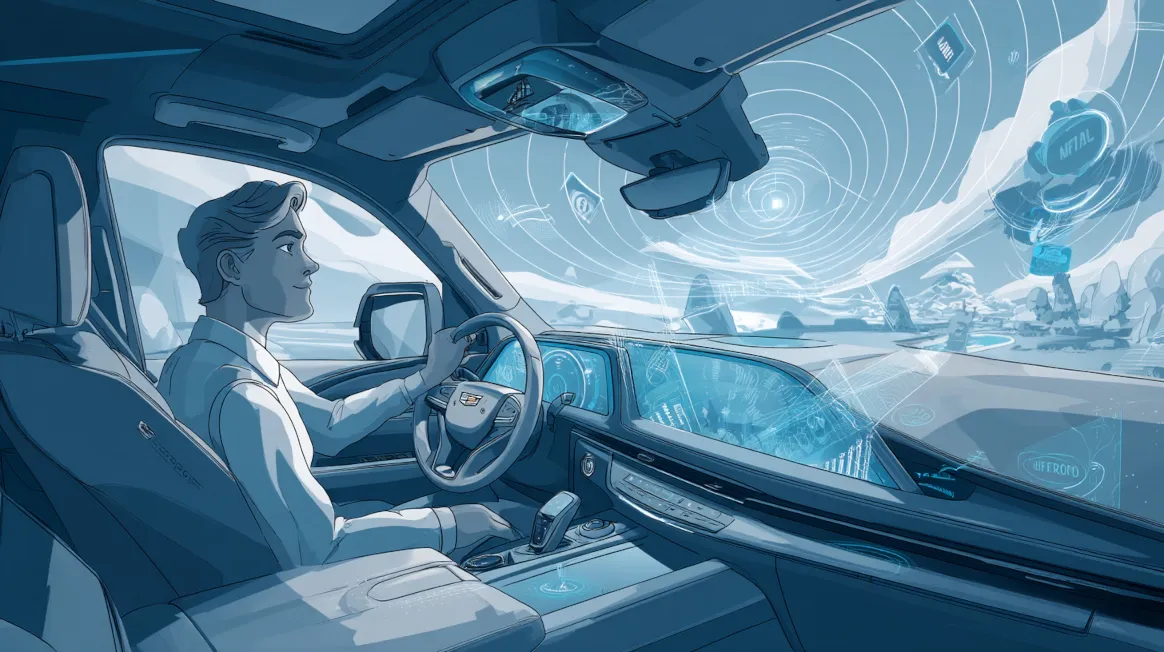
Conclusion: What GM’s AI Revolution Means for Drivers and the Road Ahead
Key Takeaways for 2025 Buyers
- 2025 is the year of confident hands-free eyes-on. Look for Super Cruise on the trims that matter and confirm the driver monitoring camera and map access.
- Eyes-off is real, defined, and dated. The Escalade IQ leads in 2028 with lidar and centralized Nvidia compute aimed at a focused highway ODD.
- Software is the long game. Expect meaningful OTA updates and a subscription model that reflects ongoing map and capability growth.
What to Watch Next Through 2030
- State approvals for Level 3 on specific highway segments and conditions.
- Expansion beyond highways as the safety case matures and data supports broader ODDs.
- True customer impact. Fewer crashes, smoother commutes, and real time savings will decide who wins, not only marketing language.
The bottom line is simple. Buy a 2025 GM for its hands-free highway composure today and the credible path to more tomorrow. Keep an eye on states that clear Level 3 use and on release notes that quietly sharpen behavior. When people say GM AI eyes-off driving 2025, think two things. A strong hands-free present. And an eyes-off future that begins in 2028 and grows from there.

About World Parts Direct
World Parts Direct is your go-to source for genuine OEM parts for GM and MOPAR vehicles. We make it easy to order factory-original parts online — shipped fast, accurately, and backed by real human support.
Every item we sell comes brand new in the manufacturer’s original packaging. Whether you’re handling routine maintenance, collision repair, or a full restoration, our parts professionals provide VIN-verified fitment support to ensure you get exactly what you need.
Serving drivers and repair shops worldwide, we proudly support brands like Chevrolet, GMC, Cadillac, Buick, Dodge, Chrysler, Jeep, and Ram. Shop confidently at WorldPartsDirect.com.