
Stellantis’ $10 Billion U.S. Investment 2025: Reviving U.S. Manufacturing and Strengthening Mopar Parts Supply
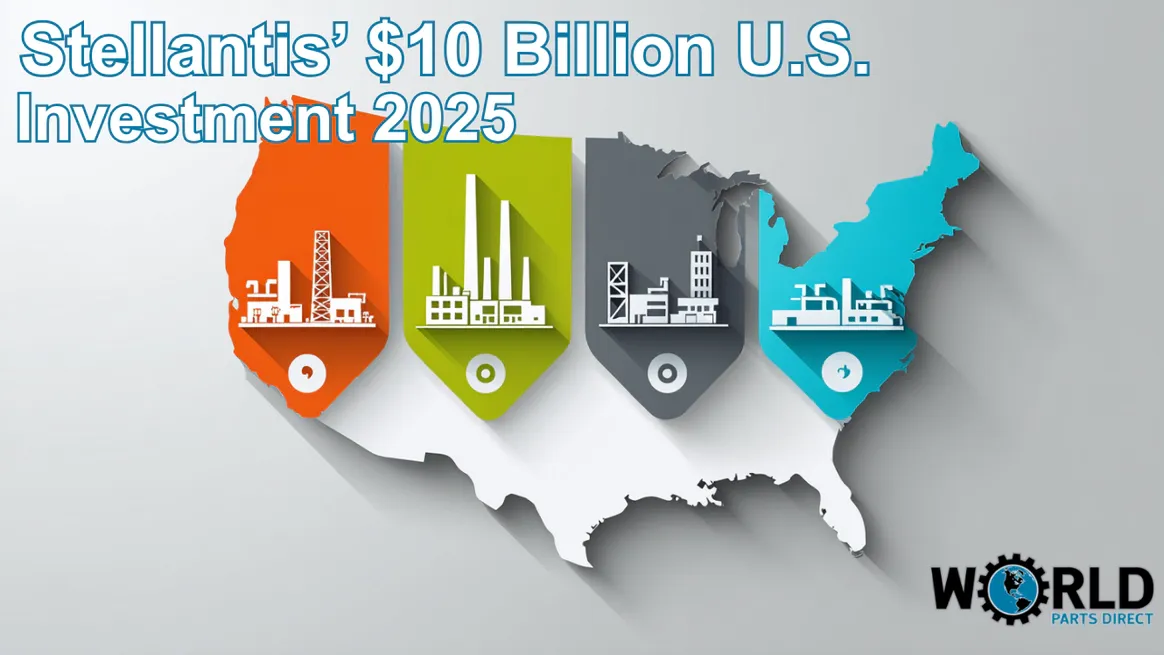
Stellantis’ $10 Billion U.S. Investment 2025
What It Means for Manufacturing and OEM Parts Availability
TL;DR:
Stellantis’ $10 billion U.S. investment marks a major shift toward domestic manufacturing, faster OEM parts delivery, and stronger supply chain stability. The plan reopens and retools plants across Illinois, Ohio, Michigan, and Indiana, adding over 5,000 jobs and boosting U.S. vehicle production by 50% through 2029.
By localizing engines, EV components, and supplier networks, Stellantis aims to cut lead times, reduce backorders, and strengthen Mopar parts availability while revitalizing the Midwest manufacturing base.
Stellantis’ $10 Billion U.S. Investment 2025
When people talk about big auto moves, they usually think new models and shiny showrooms. The bigger story is happening behind the factory doors. The Stellantis U.S. investment 2025 is a bet on domestic production, faster parts flow, and a more stable supply base that reaches service bays as much as it reaches sales floors.
Over the past year, Stellantis publicly outlined a multi-year plan for U.S. growth that totals $13 billion through 2029 and includes plant reopenings, retooling, and five new vehicle launches, with more than 5,000 jobs planned across Illinois, Ohio, Michigan, and Indiana.
That headline number sits on top of a pivot that industry watchers initially framed around a roughly $10 billion manufacturing push in 2025. The signal is clear. Production is coming home, and with it, the parts pipeline that keeps Mopar humming.
Direct answer: Stellantis’ 2025 U.S. investment focuses on retooling and reopening plants, localizing key components, and launching new Jeep, Ram, Dodge, and Chrysler programs. Expect shorter lead times on OEM parts, fewer backorders, and steadier dealer inventories as domestic capacity grows, while new jobs and supplier localization reshape regional economies.
Impact Overview: Why the $10B Move Matters for U.S. Manufacturing and Parts
There is a reason this move grabbed attention. Stellantis committed to expand U.S. finished vehicle production by about 50 percent over current levels and to launch five new vehicles in the next four years, alongside 19 product actions and updated powertrains through 2029.
A surge of that size changes the math on labor, logistics, tariffs, and inventory. It also resets expectations for parts availability. Plants that build here tend to pull suppliers closer. Suppliers that move closer tend to cut transit time and risk. That loop quietly lowers costs and raises service reliability.
Context matters. Stellantis had seen pricing power and profits climb through 2023, but market share in the U.S. slipped roughly five points over about five years as high prices and slower product refreshes played a part.
Management responded with a sweeping U.S. reinvestment plan after a difficult 2024 and a net loss in early 2025, and called out tariff exposure that could cost about $1.7 billion in 2025 if left unaddressed. That is not just an accounting line. Imported parts and vehicles face policy headwinds that push companies to localize or pay. The investment reduces that exposure and improves eligibility for federal and state incentives.
The parts story runs through Mopar. Service managers feel it in the morning when the delivery truck shows up. Shorter routes mean fewer surprises. Domestic retooling and program launches usually bring new supplier contracts with higher on-time benchmarks. While the full benefits arrive as plants ramp through the decade, some relief begins sooner.
The early wins show up as fill-rate improvements on fast movers, fewer line-stopping backorders, and steadier warranty parts flow as component families are standardized across nameplates.
There is also a community angle. The reopening of Belvidere in Illinois, rebooted build plans in Toledo and Warren, and new engine work in Kokomo add thousands of jobs and anchor supplier networks across the Midwest. Plants do not operate in a vacuum. Every added shift brings vendor vans, union training halls, and diners that fill for third-shift breakfasts. People see it, hear it, and count on it.
Stellantis US investment 2025: scope, timeline, and strategic goals
Capital allocation by program and plant
The public plan blends manufacturing upgrades with product engineering and supplier tooling. Plant-level allocations identified so far include reopening and retooling work that ties directly to specific nameplates and powertrains. The larger $13 billion through 2029 also covers R&D and supplier costs beyond the plant walls.
| Plant or program | State | Investment focus | Announced amount | Timing |
|---|---|---|---|---|
| Belvidere Assembly | Illinois | Reopen plant for Jeep Cherokee and Compass | More than $600 million | Initial launch expected 2027 |
| Toledo Assembly Complex | Ohio | All-new midsize truck build shift to Toledo | Nearly $400 million | Launch expected 2028 |
| Warren Truck Assembly | Michigan | All-new range-extended EV and ICE large SUV | Nearly $100 million | Production beginning 2028 |
| Detroit Assembly Complex – Jefferson | Michigan | Next-generation Dodge Durango prep | About $130 million | Launch anticipated 2029 |
| Kokomo facilities | Indiana | GMET4 EVO four-cylinder engine production | More than $100 million | Beginning 2026 |
Note. The investment plan includes broader engineering and supplier spend tied to five new vehicles and 19 product actions through 2029. Plant-specific amounts above reflect manufacturing allocations disclosed to date.
Strategic objectives: localization, cost, and speed to market
- Localize to reduce tariff exposure and freight volatility. Stellantis flagged trade barriers as a material cost in 2025. More U.S. production reduces that risk and stabilizes pricing strategy.
- Standardize architectures to scale parts families. Shared components across Jeep, Ram, Dodge, and Chrysler streamline Mopar inventory and quicken service parts availability.
- Shorten cycle time from design to lot. Proximity between engineering, tooling, and assembly helps trim weeks from changeovers and service campaign responses.
- Rebuild U.S. share with fresher products. Five new vehicles plus 19 refreshes through 2029 reset showroom appeal after a stretch of stale offerings that eroded share.
Governance, partners, and JV structures
Public disclosures for this phase focus on Stellantis-owned plant investments with supplier participation via tooling and capitalized equipment. Joint ventures for batteries and advanced components remain part of the global strategy, though program-level partners were not detailed in the October 2025 U.S. release and will likely be announced case by case as vehicle and component sourcing is finalized.
Supplier localization commitments will accompany each plant ramp and will be reflected in state development packages, which are still subject to negotiation and final approval.
Manufacturing footprint: new plants, retooling, and capacity expansions
Retooling and capacity expansions at legacy assembly plants
Retooling breathes new life into legacy facilities. Belvidere carries symbolic and operational weight, moving from idled to active with a dual Jeep program slated for 2027. Toledo adds a midsize truck alongside Wrangler and Gladiator, which bring their own product actions and machining support.
Warren Truck prepares for a range-extended EV and an ICE large SUV, a pointed sign that Stellantis will run a mixed propulsion strategy where customer demand and regulations warrant it. Detroit’s Jefferson complex sets up next-gen Durango for later in the decade.
Retooling campaigns affect parts in two ways. First, they often consolidate supplier families around updated architectures. That cuts complexity for service parts ordering. Second, they introduce new quality gates and traceability systems that help field teams diagnose issues faster and process warranty claims with greater accuracy.
No one celebrates a retool for its barcode labels, yet those labels speed a recall fix by days when a batch problem is identified at a supplier.
New or expanded battery and component facilities
The current public plan centers on assembly, engine, and machining footprints in the Midwest. Battery and drive unit siting for the named products was not fully specified in the October release.
Given IRA rules and logistics realities, expect domestic pack and drive unit content to be aligned with range-extended EV programs as they approach the 2028 window. Announcements typically trail vehicle reveals, and supplier JVs are often disclosed alongside state incentive packages. Status. needs confirmation.
Regional distribution of investments across the U.S.
| Region | States highlighted | Focus | Expected jobs |
|---|---|---|---|
| Midwest core | Illinois, Ohio, Michigan, Indiana | Assembly reopens, retooling, new powertrain | More than 5,000 across plants |
| Supplier belt | Adjacent Midwest and Great Lakes | Tooling, stamping, machining, logistics hubs | Multiplier effects tied to plant ramps |
State-by-state development packages will shape the final map. Investments are subject to successful negotiation and approval at the state and local level, which will influence supplier clustering and distribution center siting over the next two to three years.
Battery and EV components: domestic content, incentives, and compliance
IRA 30D and 45X rules and domestic content thresholds
The Inflation Reduction Act ties consumer and production credits to how and where EV components and critical minerals are sourced and assembled.
Two anchors matter most for Stellantis programs in this window. Section 30D consumer credits for qualifying vehicles assembled in North America and Section 45X production credits for manufacturing battery components and critical materials domestically. The precise thresholds and phase-ins change over time and require program-by-program validation with suppliers.
- Final assembly in North America for 30D eligibility. Applies to the vehicle. Requires VIN-level validation at sale time. Status.
- Battery component and critical mineral sourcing requirements that tighten annually. Program managers will adjust sourcing to protect eligibility where consumer credits are central to pricing.
- 45X production credits incentivize domestic battery component output. These can materially affect pack and cell siting decisions for programs like the range-extended SUV slated for Warren. Status.
The practical takeaway. Stellantis has a financial reason to localize cells or packs and to trace mineral content carefully. Those incentives compound with tariff risks already flagged by the company as a headwind for 2025, which strengthens the case for domestic or USMCA regional supply.
Recycling, remanufacturing, and second-life programs
Recycling and remanufacturing will matter more as the EV mix grows. The company’s history with reman engines and transmissions through Mopar provides a template for battery modules and e-axles.
Expect more core-return logistics, module-level refurbishment, and second-life energy storage pilots as the 2028 programs mature. These efforts reduce cost of ownership and create a domestic stream of usable components for service parts catalogs. Status.
Supply chain resilience: sourcing, logistics, and semiconductor strategy
Nearshoring under USMCA and supplier localization
USMCA rules already reward North American content. Layer in tariffs and IRA incentives and the logic becomes overwhelming. Stellantis’ expanded U.S. mix shifts supplier negotiations toward domestic and regional commitments, with tooling amortized across multiple nameplates to hit the volume needed for competitive pricing.
The payback shows up in lower ocean freight exposure, faster changeovers, and less currency risk. People in the shop say it simply. The part either shows up or the bay sits cold.
- Tooling colocated with assembly lines to cut days out of service part builds.
- Regional raw material contracts for steel, aluminum, and resins to steady pricing for fast-moving spares.
- Supplier scorecards that tie bonuses to backorder avoidance and premium freight reduction.
Semiconductor sourcing and long-term supply agreements
Semiconductors are still the wildcard. Long-term supply agreements that tie allocation to program ramps remain standard practice. Stellantis’ move to stabilize U.S. production volumes creates clearer demand signals that chipmakers favor.
That helps reduce the stop-start cadence that wrecked planning during the pandemic period. As domestic chip fabs scale, expect more dual-sourcing and redesigns for parts that can run on multi-vendor chips. Status.
Logistics optimization across ports, rail, and cross-border routes
Logistics value hides in plain sight. With more Midwest output, the network shifts toward rail and truck corridors that feed national distribution centers. The move away from congested ocean port lanes should cut lead time variability for both vehicles and parts.
Cross-border routes still matter for USMCA content. The difference is less dependency on long-haul ocean containers and more usage of time-definite rail and dedicated trucking for service replenishment.
- Map part families to fastest route. Assign high-turn service parts to domestic lanes to shrink lead times.
- Use forward stocking at regional DCs. Pre-position warranty kits for campaigns to speed first-time fix.
- Audit premium freight. Target root causes in supplier schedules and DC wave planning.
Jobs and regional economic development: where hiring and training will grow
Workforce development, apprenticeships, and reskilling
More than 5,000 new jobs are expected to come online across Illinois, Ohio, Michigan, and Indiana as these programs ramp. That means apprenticeships, mechatronics training, and updated safety and quality certifications.
Union halls and community colleges usually partner to fill the pipeline. For service organizations, that also means better access to trained technicians graduating from the same regional programs that feed the plants. Shared standards for torque, diagnostics, and high-voltage safety carry over to service bays.
State incentives, site selection, and local multipliers
Each investment is subject to negotiation and approval of development packages. Site selection reflects not only incentives but also logistics and supplier base maturity. The local multipliers are familiar.
One assembly job supports many more in stamping, injection molding, warehousing, and food service. Municipalities see tax bases broaden. School districts see new sponsorships. The timeline from MOU to ribbon cutting can be long, but the economic signal arrives early and draws suppliers in its wake.
Labor relations and wage trends
Labor relations set the tone for everything else. The plan to reopen Belvidere follows a tense period and aligns with commitments made in discussions with the UAW regarding job restoration tied to new programs.
Stable labor agreements with clear wage paths help Stellantis hit quality and cost targets, and they lower the risk of strike-driven delays that ripple through dealer inventory and parts supply. The Belvidere commitment has been described as a watershed moment for rebuilding trust in the Midwest footprint.
Model pipeline and production mix across Jeep, Ram, Dodge, and Chrysler
Confirmed and rumored nameplates and trims
- Jeep Cherokee and Jeep Compass return to Belvidere. These are confirmed for U.S. assembly as the plant reopens with an initial 2027 launch.
- All-new midsize truck to Toledo. The program shifts from prior plans and joins Wrangler and Gladiator, with launch expected in 2028.
- Large SUV at Warren. An all-new range-extended EV and an ICE variant are planned for production starting in 2028.
- Next-generation Dodge Durango at Detroit’s Jefferson. Launch is anticipated for 2029 with fresh tech and packaging.
Rumor mills will point to Dodge muscle and a broader Chrysler lineup refresh over the longer term. Those discussions reflect brand ambitions, yet only the programs above carry public timelines and plant allocations. Status for rumored items. needs confirmation.
Capacity allocation by segment and propulsion
The mix will skew toward SUVs and trucks where Stellantis brands compete strongest. Range-extended EV at Warren is a notable hedge that marries electric drive with longer-haul usability. ICE remains in play where customers still buy it and where rules allow.
Expect a portfolio that keeps towing and off-road credentials while adding electrified torque and more efficient engines like the GMET4 EVO four cylinder scheduled to begin production in Kokomo in 2026.
EV rollout cadence versus ICE sunset timelines
Five new vehicles and 19 additional product actions through 2029 suggest a steady cadence rather than a single-year spike. The pace gives dealers time to adapt service tools and gives suppliers time to calibrate. ICE sunset timelines will vary by segment and region.
Many customers in truck and SUV segments still demand range and payload that are best addressed with mixed propulsion in the near term. The Warren range-extended SUV underlines that reality.
OEM parts availability impacts for Mopar service and warranty support
Mopar distribution centers, fill rates, and backorder reduction
The near-term promise is simple. More domestic production means more predictable replenishment into Mopar DCs. As programs consolidate component families, Mopar can lower SKU complexity without starving dealers of choice.
Fill rates on high-frequency parts usually move first. Expect steady progress on backorder days outstanding as suppliers bring secondary tooling onshore and as DCs implement wave planning tuned to the new model mix.
- Fast-track kits for common warranty repairs pre-positioned at regional DCs.
- Dual sourcing on critical electronics to cut single-point failures.
- Closer alignment between plant production schedules and service parts builds to avoid shortages during launches.
Warranty parts, recalls, and service bay throughput
Warranty programs benefit from traceability and domestic rework capacity. When a campaign hits, proximity helps. Plants can spin service part campaigns quickly, and suppliers can stand up rework cells in the region.
The real-world impact is higher first-time fix rates and shorter vehicle downtime. Service bays move faster when the right part shows up on the first truck, not the third. During the pandemic, too many shops waited with vehicles stuck on lifts. The goal here is the opposite experience.
Fast movers versus slow movers: expected lead times
| Part category | Examples | Lead time trend as capacity ramps |
|---|---|---|
| Fast movers | Filters, sensors, brake wear items | Improve first, days to a week |
| Medium movers | Lighting, trim, suspension modules | Improve with retooled supply, one to three weeks |
| Slow movers | Body panels, unique electronics, interior assemblies | Gradual improvement, weeks to months |
These are directional patterns, not promises. Dealer parts managers should plan against current performance while watching ramp milestones in Belvidere, Toledo, and Warren that unlock additional improvements as new supplier lines stabilize.

Dealer network and aftermarket: pricing, lead times, and inventory dynamics
Allocation, floorplanning, and inventory normalization
Production that grows by about half sets the stage for dealer inventory normalization. Allocation will reflect regional demand for Jeep and Ram core segments with Dodge and Chrysler product cadence filling in. Floorplanning costs fall as days’ supply returns to healthy levels. That stabilizes margins and reduces the temptation to over-order slow combinations just to have cars on the lot.
Expect a more predictable rhythm of transport from Midwest plants to regional hubs, which helps delivery ETAs feel real again.
Pricing discipline, incentives, and MSRP stability
Stellantis saw the downside of leaning too hard on price during the shortage era. Analysts called out the company as an outlier among peers on the size of pandemic-era price increases, and that helped push shoppers to rivals as inventories normalized.
The new capacity and product cadence are built to restore competitiveness and lessen the need for heavy incentives or sharp-list pricing games that confuse customers and punish brand equity.
Aftermarket compatibility and right-to-repair considerations
As more electronics and electrified systems enter the fleet, aftermarket compatibility questions multiply. Stellantis’ localization push raises the odds of domestic component suppliers offering validated equivalents under licensing or through aftermarket brands. Right-to-repair continues to evolve across states.
Clear diagnostic access and parts availability through Mopar will shape technician trust, while third-party options will grow as the new platforms mature and patents cycle. Expect a lag between new model launches and robust aftermarket coverage, which is normal in any cycle.
Risks and competitive context: policy, labor, and rival investments
Policy, tariffs, and regulatory scenarios
Policy sits in the driver’s seat as much as product. Stellantis explicitly cited trade barriers that could cost the company about $1.7 billion in 2025. Shifting manufacturing to the U.S. or within USMCA mitigates those costs and helps vehicles qualify for incentives that are central to EV affordability.
Regulatory risk will not disappear, but domestic production gives Stellantis more levers than importing into a shifting tariff landscape.
UAW dynamics, strikes, and contract terms
Labor stability is priceless in a ramp. The Belvidere reopening is both symbolism and substance for a union relationship that had grown strained. Contracts that clarify wages, overtime, and investment commitments reduce the chance of mid-ramp disruptions. Every lost week at a plant reverberates in parts availability and dealer confidence.
The Midwest footprint makes it easier to align training, quality goals, and safety programs. It also means both sides live with the same weather and the same local headlines, which tends to focus minds in a good way.
How Stellantis compares to GM, Ford, Toyota, and Hyundai-Kia
Rivals are not standing still. Hyundai laid out a plan to reach $26 billion in U.S. investment through 2028, adding EV capacity and countering tariffs. Detroit rivals have their own battery plants and retooling cycles under way. Stellantis is now putting real money on the table after a period of perceived hesitancy.
The company’s plan to lift U.S. output by about half, launch five new vehicles, and refresh 19 more through 2029 puts it back in the conversation among the most aggressive rebuilds in the market, with the most visible early marker being Belvidere’s return.
Timeline and milestones through 2025 and beyond
2024–2025 ramp checkpoints
- Finalize state and local development packages for named plant investments. Investments are subject to successful negotiation and final approval.
- Lock supplier awards for 2026 to 2028 programs and stand up tooling for service parts in parallel with vehicle lines.
- Implement DC planning changes to anticipate new parts families tied to Jeep and Dodge programs.
2026–2028 expansion phases and capacity targets
| Year | Milestone | Plant or program |
|---|---|---|
| 2026 | GMET4 EVO engine production start | Kokomo, Indiana |
| 2027 | Belvidere assembly relaunch | Jeep Cherokee and Compass |
| 2028 | Midsize truck launch in Toledo | Ohio |
| 2028 | Large SUV production at Warren | Michigan |
| 2029 | Next-gen Dodge Durango production | Detroit Assembly Complex – Jefferson |
The broader $13 billion umbrella through 2029 also includes five new vehicles and a regular cadence of 19 refreshed products across all U.S. plants. Annual finished vehicle production is targeted to increase by about 50 percent from current levels as these ramps mature.
KPIs to watch for parts availability and throughput
- Dealer fill rate by part family. Watch fast movers first.
- Backorder days outstanding for top 100 SKUs. Aim for steady declines.
- Premium freight expense as a percent of parts revenue. Lower is better.
- First-time fix rate on warranty campaigns for new models. Early indicator of both quality and parts planning.
- Supplier on-time delivery to Mopar DCs. Track consistency through the ramp.
Conclusion
Stellantis’ $10 billion U.S. investment marks a major turning point for American auto manufacturing and the parts ecosystem that keeps vehicles on the road. By bringing production home, retooling legacy plants, and launching new models, Stellantis is betting on shorter lead times, fewer parts shortages, and a more resilient supply chain that benefits dealers, service managers, and customers alike.
The ripple effects reach far beyond factory gates; thousands of new jobs, fresh supplier networks, and a revitalized Midwest manufacturing corridor signal a renewed commitment to domestic capability. As these programs roll out, expect more predictable inventories, steadier pricing, and a service experience that feels less like crisis management and more like clockwork.
The next few years will test how well these investments translate into real-world improvements, but the early signs point to a stronger, more stable future for Stellantis and its U.S. customers
.

About World Parts Direct
World Parts Direct is your go-to source for genuine OEM parts for GM and MOPAR vehicles. We make it easy to order factory-original parts online — shipped fast, accurately, and backed by real human support.
Every item we sell comes brand new in the manufacturer’s original packaging. Whether you’re handling routine maintenance, collision repair, or a full restoration, our parts professionals provide VIN-verified fitment support to ensure you get exactly what you need.
Serving drivers and repair shops worldwide, we proudly support brands like Chevrolet, GMC, Cadillac, Buick, Dodge, Chrysler, Jeep, and Ram. Shop confidently at WorldPartsDirect.com.